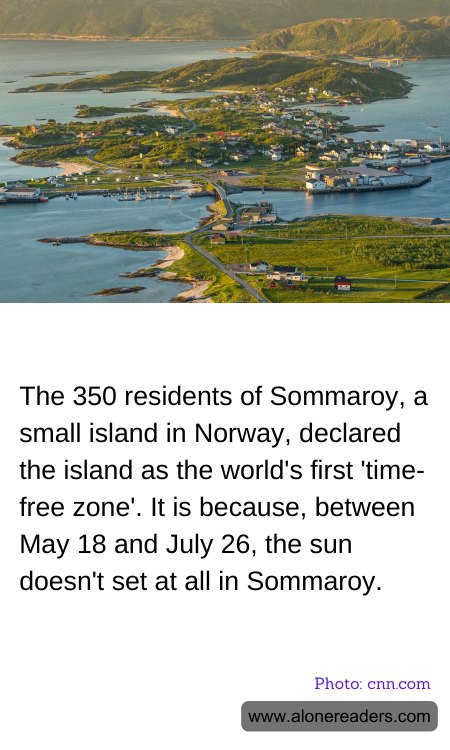
Sommaroy, a charming little island located in Norway, has been declared by its 350 residents as the world's first 'time-free zone,' an innovative concept that challenges conventional notions of time and daily routines. This unique declaration is a response to the island's exceptional geographical and astronomical conditions, where between May 18 and July 26, the sun does not set at all.
This phenomenon, known as the Midnight Sun, occurs due to the island's position within the Arctic Circle, where the angle of the Earth's axis ensures continuous daylight during these summer months. The extended daylight disrupts the traditional night-day cycle, leading to unique living conditions for the island's inhabitants.
The time-free zone initiative reflects the locals' desire to optimize their productivity and well-being by living in a more natural, time-flexible manner. Without the constraints of a conventional timekeeping system, residents are free to engage in fishing, hiking, or even mowing their lawns at what would normally be considered the middle of the night. This shift away from a structured schedule aims to maximize the potential offered by endless days.
The decision by Sommaroy's residents has drawn global attention, with many intrigued by the community's adjustment to such an extraordinary natural event. Visitors to the island during this period are encouraged to embrace this liberated temporal lifestyle, which includes ignoring clocks and experiencing life dictated by personal needs and the rhythms of nature rather than the ticking of a clock.
The time-free zone concept poses interesting questions about the way modern societies perceive and structure time. It highlights a rare approach to living harmoniously within a natural phenomenon by reshaping social constructs that often go unchallenged. As the world becomes more interconnected and lifestyles more standardized, Sommaroy stands as a testament to the human capacity for adaptability and reimagining the potential of community living under unique environmental conditions.
