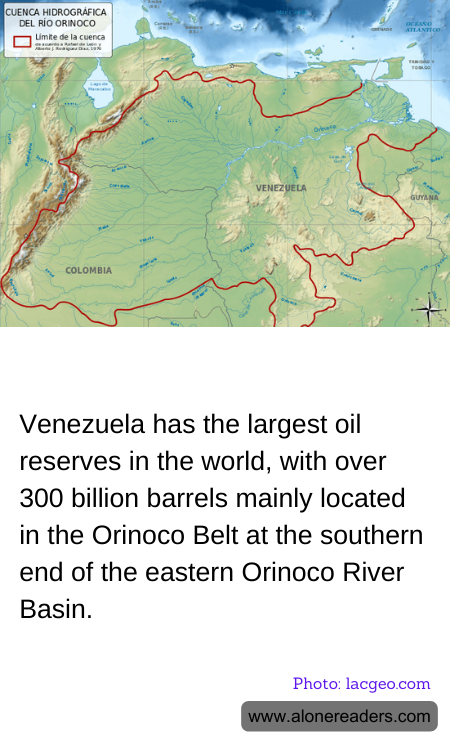
Venezuela, a country with a sprawling landscape that stretches from the peaks of the Andes in the west to the iconic Angel Falls in the east, holds beneath its surface the world’s largest oil reserves. With an estimated 300 billion barrels, these vast reserves surpass those of Saudi Arabia, traditionally seen as the world’s oil powerhouse. The majority of these reserves are found in the Orinocan heavy oil belt in the Orinoco River Basin, a territory that covers about 55,314 square kilometers of land in the southern end of the country.
This immense wealth, however, has been both a boon and a burden for Venezuela. On one hand, the oil industry has historically been the backbone of the Venezuelan economy, powering growth and funding social programs. It accounts for about 98% of the country’s export earnings and more than half of the government's revenue. This has allowed Venezuela, at times, to assert significant influence in the global oil market and pursue an agenda of economic independence and social welfare at home.
On the other hand, reliance on oil has made Venezuela extremely vulnerable to fluctuations in oil prices. The global drop in oil prices that began in 2014 severely impacted the Venezuelan economy, exacerbating political and economic crises. The nation has since struggled with hyperinflation, shortages of basic goods, and a mass exodus of its citizens.
Moreover, the extraction of oil, particularly in the heavy crude-rich Orinoco Belt, presents substantial environmental and technical challenges. The heavy crude found in this region is more carbon-intensive and environmentally damaging to extract and process compared to lighter crudes. This poses significant environmental risks, including threats to local waterways, wildlife, and the broader ecosystem, which could have lasting adverse effects on the country’s rich biodiversity.
The management of Venezuela’s oil resources has also been fraught with political controversy and governance issues. Corruption, mismanagement, and economic sanctions have further hampered the effective development of the oil sector. This has led to a decline in production levels and has left the country struggling to capitalize fully on its oil wealth.
As Venezuela looks to the future, it faces the dual challenge of revitalizing its oil industry and diversifying its economy to reduce dependence on oil. This will require substantial investment, modernization of its oil extraction and refining infrastructure, and a renewed focus on governance and transparency. Additionally, the global shift towards renewable energy sources and the pressures of climate change necessitate a strategic rethinking of how Venezuela leverages its natural resources in a way that ensures economic stability and sustainability.
