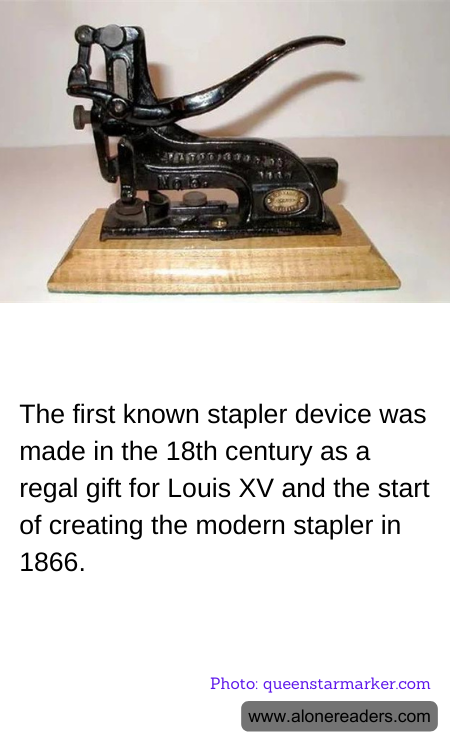
The invention of the stapler brings together a blend of utilitarian design and historical curiosities. The roots of the modern stapler stretch back to 18th century France, where the first known device resembling a stapler was crafted. This early adaptation was not intended for masses but was a bespoke item created as an elaborate gift for King Louis XV. Each staple used in this device was inscribed with the insignia of the royal court, reflecting its regality and the monarch's eminent status.
However, the evolution from a royal novelty to an everyday office staple began in earnest in 1866. This was when the foundations of the modern stapler were laid down by George McGill, who patented a small, bendable brass paper fastener, which was a precursor to the modern staple. A few years later, McGill introduced a press to insert these fasteners into papers. Though rudimentary, these inventions signaled a significant shift towards mechanical fastening devices.
It wasn't until 1877 that the first commercially successful stapler—the McGill Single-Stroke Staple Press—was brought into the market, capable of inserting a single staple through several sheets of paper. As the demands of the professional and bureaucratic paperwork grew, so too did the design and functionality of the stapler, evolving into the more familiar top-loading machine by the late 19th and early 20th centuries.
Advancements in technology and materials in the following years allowed for the development of more durable, efficient, and safer staplers. Today, staplers can be found in various forms from miniature, portable devices to heavy-duty electric models, demonstrably showing the extent to which a simple concept for binding paper has transformed into an indispensable tool in homes and offices around the world. This journey from a royal gift to a common office supply highlights not only the evolution of a tool but also the dynamic changes in how societies function and organize information.
