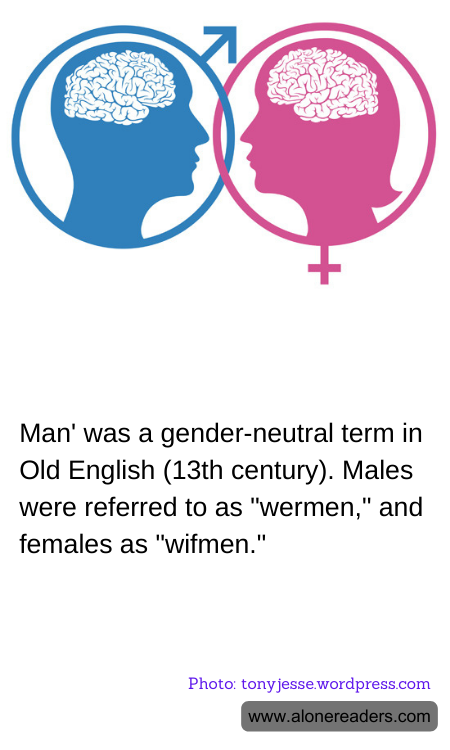
In exploring the etymology of the English language, it's fascinating to uncover that the term ‘man’ was originally gender-neutral in Old English. Dating back to the 13th century, this usage starkly contrasts with contemporary applications, where ‘man’ has evolved to primarily denote adult males. Historically, the word derived from the Proto-Germanic '*mann-' meaning person or human being, devoid of any specific gender connotations.
In those times, to distinguish between sexes, other terms were employed: 'wermen' for males and 'wifmen' for females. The prefix ‘wer’ in Old English, akin to ‘vir’ in Latin, represented man in the sense of a male human. In contrast, ‘wif’ referred to a woman, and its permutations are notably preserved in the modern word ‘wife,’ signifying a female spouse. The term ‘wifmen’ eventually evolved into ‘women,’ adopting its contemporary form and usage around the 14th century.
Understanding this linguistic evolution is crucial not only from a lexicographical viewpoint but also in illuminational societal norms and shifts in gender perception over centuries. The original gender neutrality of ‘man’ points to a more inclusive ancient understanding of people, a nuance that got skewed as language and societal structures evolved to create more distinct gender roles.
Today, language continues to adapt, reflecting and shaping the society's understanding of gender. Terms that were once specifically gendered are now challenged or reclaimed, and new terms have emerged as society becomes increasingly aware of gender diversity. The fluidity of language — reflected in the transformation of terms and perceptions from Old English to the present — encapsulates a dynamic tool for cultural expression and societal identity, continually reshaping itself to meet the communicational needs of its time.
