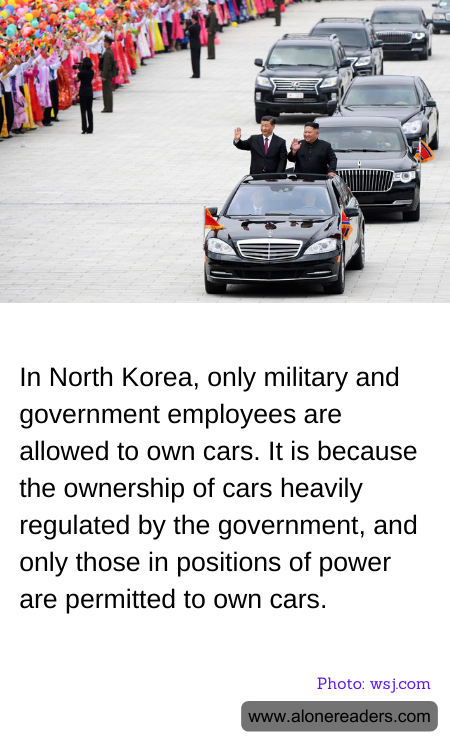
In North Korea, the ownership of cars is a privilege extended almost exclusively to military and government officials reflecting the country’s stringent social stratification and control mechanisms. This policy is part of broader efforts by the North Korean government to maintain a tight grip on both the economy and the mobility of its citizens. The regulation also underscores the vast economic disparities between the elite and the general population.
Only those holding positions of significant power and influence within the state apparatus are permitted to own and operate vehicles. This elite group includes high-ranking military personnel, key government officials, and a few members of select organizations with close ties to the government. The policy not only highlights the regime's centralized control but also serves as a symbol of status and power reserved for North Korea's most influential figures.
The general population, on the other hand, rarely experiences private car ownership. For many North Koreans, the primary means of transportation includes bicycles, ox carts, and a limited public transport system, which consists of aging buses and trains that cover a sparse network. This lack of personal transportation options reflects the country’s broader economic challenges, including severe fuel shortages and an emphasis on military spending over infrastructure or civilian needs.
Moreover, the restriction on car ownership is a tactical measure, limiting the ability of ordinary citizens to travel freely within the country. This helps the regime maintain control over the movement of people and information, a central tenet of its overarching strategy to prevent dissent and restrict exposure to external influences. The ability to control who can move, where, and how quickly is crucial for the stability of the North Korean leadership, which relies heavily on isolation and information control to sustain its power.
As such, in North Korea, cars are much more than just a means of transportation; they are tools of power used by the government to enforce its rule and symbolize the divide between the governing elite and the general populace. While this policy has effectively sustained the status quo, it also perpetuates a system of inequality and restricts the economic potential of the country by limiting mobility and freedom for the majority of its citizens.
