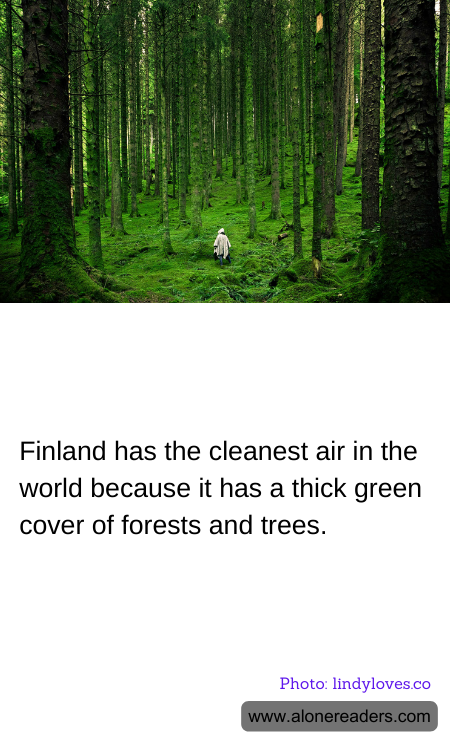
Finland is renowned for having the cleanest air in the world, a notable accomplishment that owes much to its expansive forests. Covering about 75% of the country, these forests act as massive air filters. Trees are natural air purifiers, absorbing carbon dioxide and other harmful gases, while emitting oxygen. The extensive forest cover in Finland thus plays a crucial role in not only maintaining but enhancing air quality.
The country's geographical location also contributes to its clean air. Positioned far from major sources of global pollution, Finland experiences minimal industrial pollution impacts compared to other industrialized nations. Strict environmental regulations further ensure that industrial emissions are kept at minimum levels, preventing significant deterioration of air quality.
Moreover, the Finnish government actively promotes sustainable practices and invests in green technology, which aids significantly in maintaining air purity. Public transportation systems are efficient and increasingly powered by renewable energy sources, decreasing the dependency on fossil fuels and reducing carbon emissions. Finland's commitment to preserving its natural resources is evident in its approach to forest management as well. Sustainable forestry practices ensure that the woodlands are not just preserved but are also allowed to thrive, which in turn supports biodiversity.
The benefits of Finland's clean air are manifold, impacting public health positively by decreasing respiratory and cardiovascular diseases attributed to air pollution. Furthermore, the pristine air quality enhances the quality of life for residents and makes Finland an attractive destination for tourists seeking natural beauty and environmental excellence.
Hence, the secret behind Finland's pure air isn't just its vast green forests, but a combination of geographic advantages, stringent environmental policies, and a commitment to sustainable development. These elements together create an environment where clean air is a natural asset, cherished and meticulously preserved for future generations.
