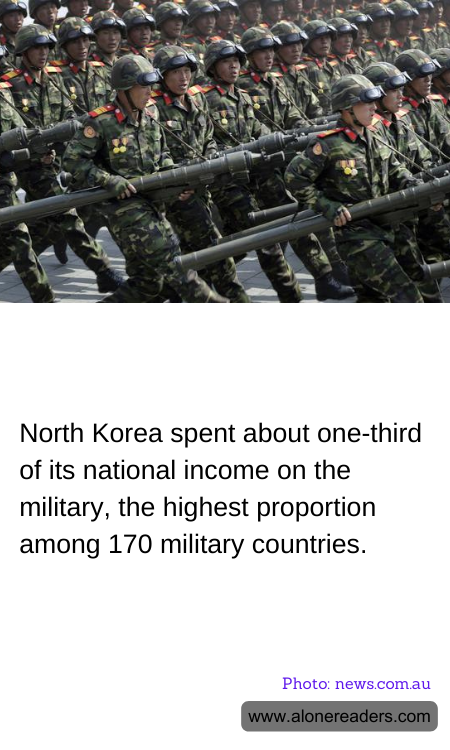
North Korea's allocation of roughly one-third of its national income to military expenditures marks it as an extreme outlier globally, dedicating the highest proportion of national income to defense among 170 surveyed countries. This prioritization emphasizes the regime's focus on military capability and defense readiness over other aspects of national development, such as healthcare, education, and economic growth. This military-first policy is a hallmark of North Korea's strategic approach, deeply influenced by its geopolitical situation and historical tensions, particularly with South Korea and the United States.
This substantial investment in the military can be understood through the lens of North Korea’s political and ideological framework. The nation's leadership, under the Kim dynasty, has long propagated the idea of "Songun" or military-first politics. This policy elevates the Korean People's Army within North Korean society, ensuring its loyalty and its pivotal role in governance. It's perceived as a necessary bulwark against external threats, especially from the U.S. and its allies, justifying extensive spending on nuclear weapons and ballistic missile technology.
The impacts of such high military spending, however, are profound and multifaceted, affecting the North Korean populace and international relations. Domestically, while this investment solidifies the regime’s power and control, it also strains an economy already burdened by sanctions, mismanagement, and limited access to international markets. North Koreans face high levels of poverty, inadequate health services, and chronic food shortages, a situation exacerbated by funds diverted to military rather than civilian reconstruction or development.
Internationally, North Korea's military focus contributes to its isolation, complicating diplomacy and increasing tensions in an already volatile region. The country's nuclear ambitions and missile tests have led to severe sanctions and diplomatic stalemates, further isolating it from potential economic assistance or foreign investment. The global community remains wary of North Korea's intentions, often viewing the nation's military activities as provocations rather than legitimate defense measures.
In conclusion, North Korea’s extreme military spending is a strategic choice deeply embedded in its political ideology and survival strategy amidst geopolitical tensions. While it serves to maintain the regime's control and asserts its presence on the global stage, the costs—both domestically and internationally—are substantial, posing significant challenges for the nation and its citizens, as well as for international peace and stability. This situation calls for a nuanced understanding and approach in international dealings with North Korea, balancing security concerns with humanitarian and diplomatic outreach to alleviate tensions and foster regional stability.
