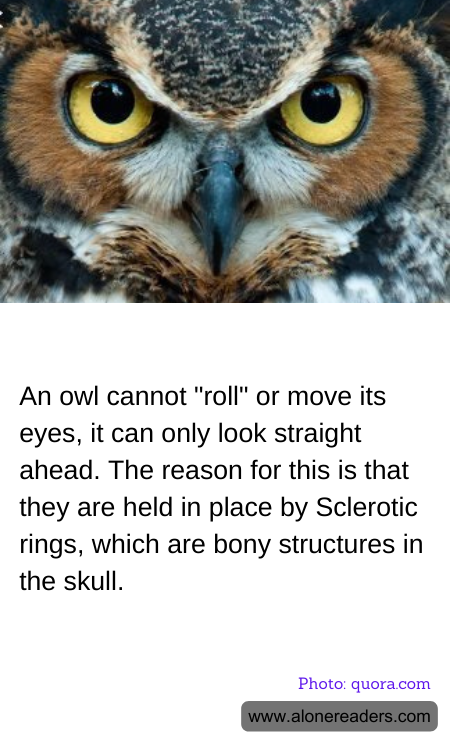
Owls are fascinating creatures often associated with wisdom and mystery. One intriguing aspect of their biology is the way they see the world. Unlike humans, who can move their eyes to follow objects or scan their surroundings, owls have eyes that are fixed in place. This unique feature stems from the owl's anatomical structure, particularly the presence of sclerotic rings—a bony structure in the skull that holds the eyes in place.
Due to this fixed eye position, owls cannot "roll" their eyes or shift their gaze side to side. Instead, their eyes are tubular and shaped more like a telescope, optimized for enhanced depth perception and focusing on objects at a distance. This design is particularly beneficial for hunting, as it allows the owl to see with incredible clarity and detail from a distance, spotting potential prey even in low light conditions.
To compensate for the inability to move their eyes, owls have developed an extraordinarily flexible neck. They can turn their heads up to 270 degrees in either direction, allowing them to look in any direction without moving their bodies. This wide range of head movement is made possible by their specialized vertebrae; owls have 14 neck vertebrae, compared to the seven found in humans, and this greater number allows for enhanced flexibility.
The combination of fixed eyes and a highly mobile neck is what enables owls to maintain such a wide field of vision. This adaptation is crucial for hunting and survival, as it allows them to spot and track moving prey with precision. The evolutionary path of owls showcases nature's ability to develop unique solutions to environmental and survival challenges, illustrating the intricate relationship between anatomy and animal behavior in the wild. This remarkable feature of owl anatomy not only underscores the diversity of avian adaptations but also highlights the complexity of evolutionary biology.
