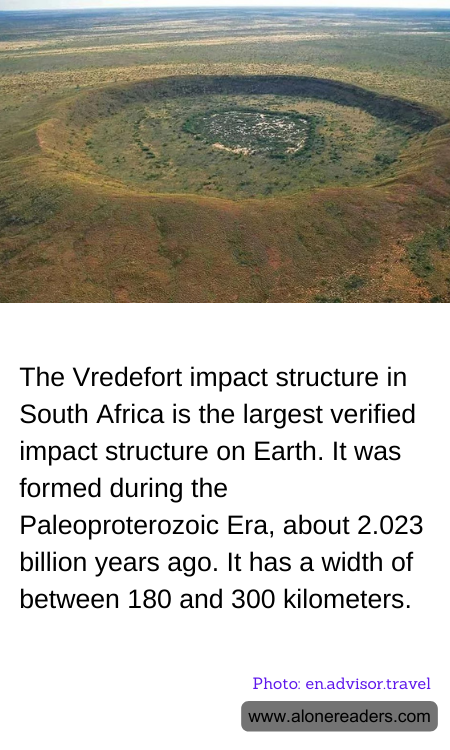
The Vredefort crater, a relic of one of the most monumental events in Earth's early history, presents a staggering example of the influence of cosmic activity on our planet. Situated in the present-day Free State Province of South Africa, this impact structure remains the largest verified crater on Earth. Formed more than two billion years ago, specifically during the Paleoproterozoic era, the Vredefort crater provides compelling evidence of a turbulent period in Earth’s geological history.
Spanning approximately between 180 to 300 kilometers in width, the crater's size indicates the massive scale of the impacting body, believed to have been an asteroid or a comet. This impact was so immense that it significantly altered the geological and environmental conditions of the Earth at the time. Scientists point out that the force generated by the impact would have released energy comparable to billions of atomic bombs, causing widespread shockwaves and heat that would have reshuffled the Earth's surface.
Today, what remains of the Vreforest impact site is a semi-circular ring of hills, a feature that astounds geologists and astronomers alike. Over the billions of years since the impact, erosion and geological processes have altered much of the original structure of the crater, yet it still provides a critical window into the processes that shape planetary bodies in our solar system. The site not only offers insights into the consequences of such colossal impacts but also into the dynamic processes that continue to sculpt the terrestrial planets.
Furthermore, the Vredefort crater has been an invaluable site for scientific study. Researchers have used this area to better understand the conditions that were present on Earth billions of years ago and how such catastrophic events could have influenced the evolution of the Earth’s environment and life. The site has also contributed significantly to our understanding of other craters throughout the solar system, providing a comparative basis for evaluating similar structures on planets like Mars and Mercury.
Recognizing its universal value and its contributions to science, the Vredefort Dome was declared a UNESCO World Heritage Site in 2005. This designation helps to protect and preserve the site for ongoing and future scientific research, ensuring that this ancient impact structure continues to educate and inspire. Whether it’s a geologist, astronomer, or simply a curious visitor, the Vredefort crater, with its rich history and monumental scale, offers a unique glimpse into the powerful forces that continue to shape our planet.
