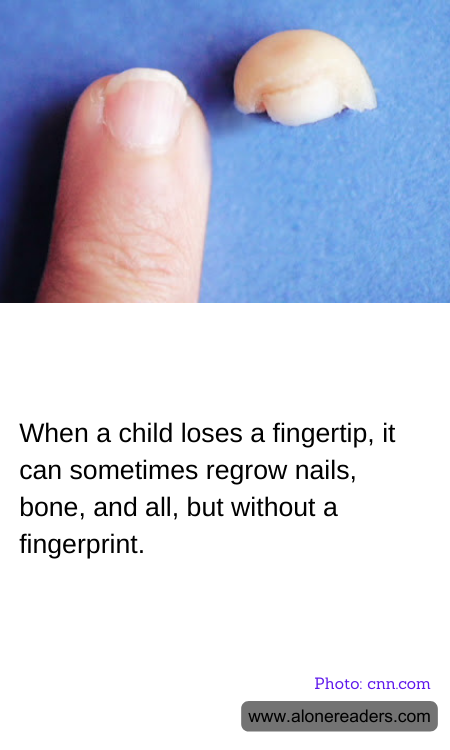
When a child suffers the unfortunate event of losing a fingertip, there's a remarkable biological process that may occur during healing, particularly in children under the age of approximately 10 years. In some cases, the lost fingertip can regrow essential components such as nails, skin, and even bone. This phenomenon, known as regenerative healing, highlights the impressive regenerative capabilities, especially evident in younger individuals.
Regenerative healing in children is largely attributed to their still-developing tissues and the high cell activity within their bodies. These unique biological conditions create an environment conducive to the regeneration of complex structures. The process involves the formation of a special type of tissue known as blastema when a fingertip is amputated or severely injured. Cells within the blastema are capable of differentiation, which means they can transform into the specific types of cells needed to reconstruct the fingertip's varied tissues, including nerves, skin, and bone.
The regrowth of nails in regenerating fingertips is a particularly interesting aspect, as it indicates not only skin and soft tissue regeneration but also the regeneration of more complex structures. The development of a new nail suggests that the regenerative processes can recreate the detailed structures that are necessary for a fully functioning fingertip. However, one notable absence in such cases of natural regrowth is that of the fingerprint. Fingerprints are formed in the womb and are highly intricate and unique to each individual. When a fingertip regenerates, the new skin does not recreate the original fingerprint patterns. This absence is a result of the regenerative process not following the original blueprint that laid out the fingerprint's unique ridges and whirls.
The reasons behind the inability to recreate fingerprints remain an area of scientific curiosity. It is hypothesized that since fingerprints do not play a direct role in the physiological functioning of the hands, the regenerative process prioritizes the recovery of functions such as tactile sensation and physical protection, which are crucial for basic hand functions.
Understanding this regenerative process opens up intriguing possibilities for medical science, particularly in the fields of tissue regeneration and healing. Research into this could potentially lead to advanced forms of regenerative therapies that could benefit not only those who have suffered minor injuries like fingertip loss but also individuals with more severe forms of physical trauma. By studying the mechanisms behind this natural regenerative capacity in children, scientists hope to unlock new avenues in regenerative medicine that may one day lead to the development of treatments that could replicate or even enhance these naturally occurring processes.
