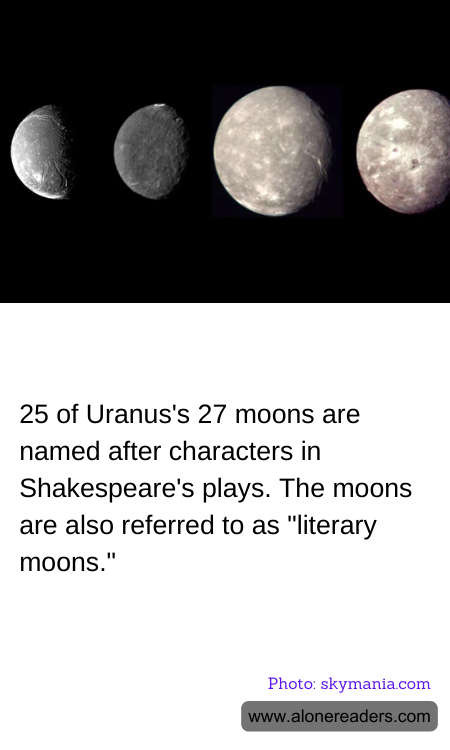
Uranus stands out in the solar system not just for its unique rotation on its side but also for the literary homage paid through the naming of its moons. Of the 27 known moons orbiting the icy planet, 25 have been named after characters from the plays of William Shakespeare, making them fondly referred to as "literary moons." This celestial connection to one of the greatest English playwrights adds a layer of cultural richness to the astronomical studies.
The tradition of naming Uranian moons after Shakespearean characters began with the discovery of Titania and Oberon in 1787 by William Herschel. Herschel, inspired by the arts and literature, chose names from "A Midsummer Night’s Dream" and "The Fairy-Queen" for the two moons. This set the precedent for future names. As more moons were discovered with the advancement of technology, particularly during the Voyager 2 spacecraft flyby in 1986, the theme continued, weaving a tapestry of Shakespeare's dramatic personae across the Uranian system.
Among these moons, the names reflect a wide array of characters from Shakespeare's works. For instance, the names Miranda from "The Tempest," Ariel, and Umbriel from "The Tempest" and "The Rape of the Lock" respectively, and Puck from "A Midsummer Night's Dream" highlight Shakespeare’s influence. Each name has been thoughtfully selected to reflect the characteristics of the moons or their orbits, embedding a subtle story within their scientific study.
This blend of literature and science not only enriches our understanding of the cosmos but also preserves the legacy of literary arts in a unique format. By linking characters from early modern English literature to celestial bodies, astronomers have bridged human culture with cosmic discovery, allowing a mnemonic resonance that aligns the arts and sciences. This interdisciplinary approach enhances public engagement with astronomy, making the distant and cold moons of Uranus slightly more familiar to the scholarly and general public alike.
Therefore, the literary moons of Uranus serve as a reminder of humanity’s enduring tradition to intertwine the exploration of the natural world with cultural expressions, creating an enduring link between our past and our ventures into the cosmic unknown.
