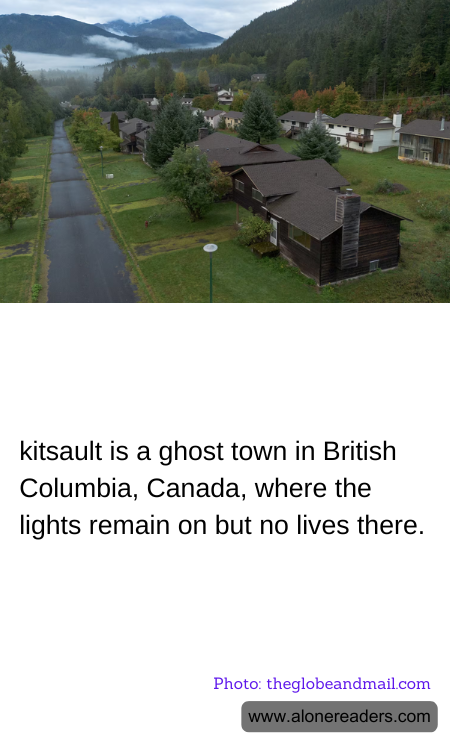
Kitsault is a fascinating ghost town located in the remote reaches of British Columbia, Canada. Nestled in the lush, dense forests along the misty coast of the province's northern region, this town stands frozen in time, with its infrastructure eerily intact and electricity still flowing. Built in 1980 to house the workers of a nearby molybdenum mine, Kitsault was designed as a utopian community, complete with modern homes, a shopping mall, hospital, sports center, and even a movie theater.
Life in Kitsault was short-lived, however. The plummeting price of molybdenum, a metal used in steel production, led to the closing of the mine in 1982, just 18 months after it had opened. Almost overnight, the town's population, peaking at around 1,200 residents, dwindled as workers and their families departed in search of new livelihoods. The town was left virtually untouched, a modern Pompeii surrounded by the wilderness.
What makes Kitsault peculiar is that it isn't abandoned in the conventional sense. The original owners, determined to preserve the town for potential future use, continued to maintain essential services. The lights are kept on, lawns are mowed, and the buildings are maintained, creating a surreal portrait of a town that is ready for inhabitants who never arrive.
In 2005, American entrepreneur Krishnan Suthanthiran purchased Kitsault with plans to transform it into a center for eco-tourism and a hub for research in clean energy and other sciences. He envisioned a revived community that could lead the way in sustainability and innovation. Despite these grand plans, significant redevelopment has yet to occur, and Kitsault remains largely as it was nearly four decades ago – pristine, quiet, and empty.
Today, Kitsault attracts photographers, urban explorers, and curious travelers drawn by its unique narrative of boom, bust, and suspended decay. Its existence raises poignant reflections on resource dependency, community displacement, and the impermanence of human endeavors. Kitsault stands as a living museum, a reminder of the transient nature of many of North America's resource towns, and a beacon of potential rebirth in an era increasingly guided by the principles of sustainability and resilience.
