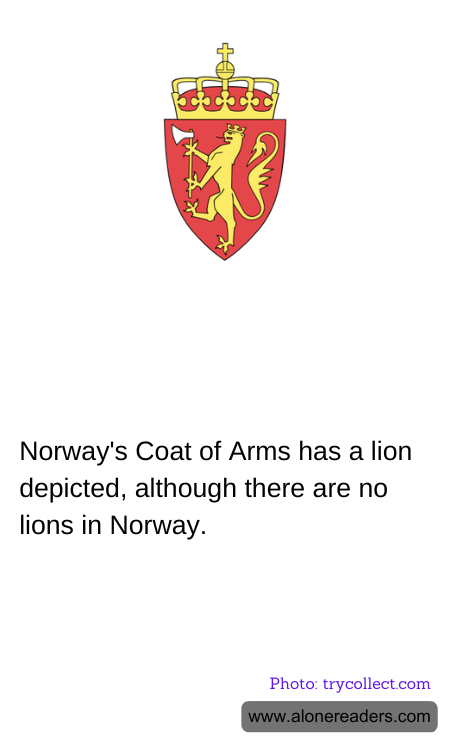
Despite the absence of lions in Norway’s natural habitat, the image of a lion prominently features in the country's coat of arms, symbolizing strength and sovereignty. The coat of arms of Norway features a golden lion on a red background, holding an axe with a silver blade. This figure is not only steeped in historical significance but also holds a rich symbolic value that transcends the geographical absence of the animal.
The origins of the lion symbol in Norway's heraldry can be traced back to the late Middle Ages, which was a time when heraldic symbolism was widely used throughout Europe to represent authority and nobility. The lion, widely recognized for its majesty and as a “king of beasts,” was an attractive symbol for medieval rulers, who often used animal symbols to represent their own qualities and the ideals of their rule.
The specific design of Norway’s coat of arms was first used by King Haakon Haakonson in the 13th century, around 1280. The lion carried a crown and axe, symbolizing the king’s power and willingness to defend the nation. Over the centuries, the design underwent several modifications but the core elements - the lion, the crown, and the axe - have remained consistent, reinforcing the symbols of divine and just rule. The axe specifically is an important element, symbolizing the Christian martyr St. Olaf, and aligning the national arms with religious symbolism and the historical narrative of Norway’s patron saint.
Aesthetically, the lion in Norway’s coat of arms is rendered in a stylized, almost mythical representation, differentiating it from the realistic depictions of lions in nature. This stylization serves as a visual reminder that the lion in this context is symbolic rather than an ecological representation. It embodies ideals like courage, strength, and the rightful use of authority — qualities that are universal and timeless.
Moreover, the continued use of this symbol plays an important role in fostering national identity and continuity, linking the modern state of Norway to its historical and cultural roots. It acts as a constant reminder of the values and the historical context upon which the nation was founded and has evolved. In essence, the Norwegian coat of arms illustrates how symbols can transcend their literal meanings and embody deeper layers of significance, enabling a nation like Norway to forge a strong and enduring cultural identity tied to shared histories and collective values.
