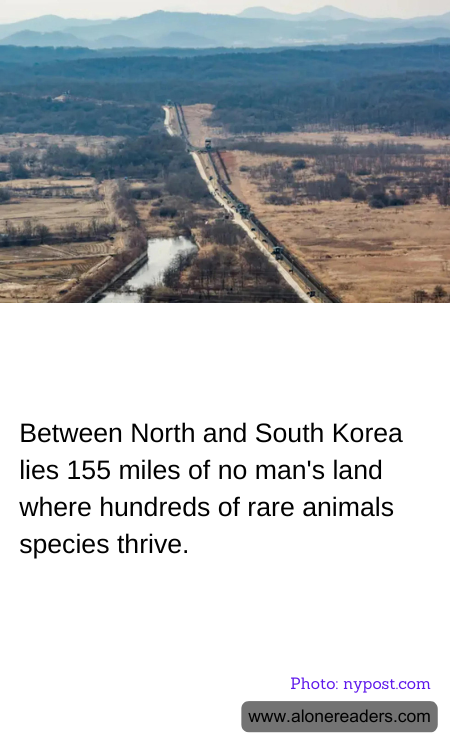
Spanning across 155 miles and up to 2.5 miles wide, the Korean Demilitarized Zone (DMZ) separates North and South Korea, serving as both a grim reminder of division and an unexpected ecological haven. Established in 1953 after the Korean Armistice Agreement, this strip of land has become an inadvertent wildlife refuge over the last seven decades, since human activity is extremely limited, by both necessity and law. The absence of human interference has allowed nature to reclaim this area, creating a biodiversity hotspot.
The DMZ is home to a surprising array of wildlife, including several species that are rare or endangered elsewhere. One of the most famous residents is the Korean Demilitarized Zone is the red-crowned crane, a symbol of longevity and fortune in East Asian cultures. This bird, along with the equally striking white-naped crane, migrates to the DMZ every year to take advantage of the safe breeding grounds. The area also supports mammals such as the Amur goral, a type of wild goat, and the Asiatic black bear, both of which are listed as vulnerable on the International Union for Conservation of Nature's (IUCN) Red List of Threatened Species.
The zone's thickets and untouched landscapes also provide critical habitats for smaller creatures, including the long-tailed goral and various species of bats. Moreover, the DMZ’s rivers and wetlands are teeming with fish species, some of which are unique to this area, forming an essential resource for the ecological food chain and for scientific study.
Despite its ecological significance, the DMZ also embodies a complex paradox; its very existence is due to political tension and military stand-offs. The continuing hostility between North and South Korea ensures the preservation of this accidental sanctuary, but it also poses a constant threat to its stability. Any escalation in conflict could lead to environmental degradation, affecting these species that rely on the zone's untouched nature for survival.
Conservationists and policymakers are thus faced with a unique challenge: how to protect this rich biodiversity amidst the fluctuating political tensions. International cooperation, along with innovative diplomatic and environmental strategies, will be crucial to ensure that the DMZ remains a sanctuary for its rare species, not just a relic of human conflict. This extraordinary no man's land, therefore, stands as a rare example of nature flourishing in the shadow of potential destruction, offering lessons in both ecology and peace.
