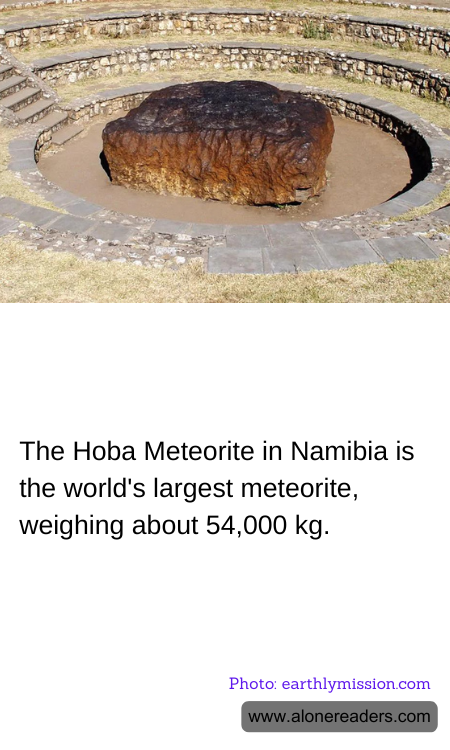
The Hoba Meteorite, located near Grootfontein in the Otjozondjupa region of Namibia, holds the title as the world's largest known meteorite. Discovered in 1920 by a farmer, Jacobus Hermanus Brits, who stumbled upon it while ploughing his field, the Hoba Meteorite is a massive chunk of metal that has amazed scientists and tourists alike. Unlike other meteorites, it has never been moved from where it fell; the colossal weight and fear of damaging it have kept it at its original landing spot.
Weighing approximately 54,000 kilograms, the meteorite is about 2.7 meters long, 2.7 meters wide, and roughly 0.9 meters high. Its composition is fascinating—about 84% iron and 16% nickel with traces of cobalt and other elements. This composition provides insights into its cosmic origins, offering clues about the nature of celestial bodies from which such meteorites originate.
The age of the Hoba Meteorite is estimated to be between 190 to 410 million years old, although it is believed to have landed on Earth approximately 80,000 years ago. Its survival without significant erosion is largely due to its metal composition and arid local climate, which has prevented significant corrosion. This in itself has made Hoba a valuable case study for understanding the preservation potential of iron-based extraterrestrial objects.
The meteorite's name comes from the farm where it was found, which in turn was likely named after a Khoekhoegowab word meaning "gift." True to its name, the Hoba Meteorite has been a gift to the scientific community and the general public alike. It was declared a National Monument in Namibia in 1955, ensuring its protection. In addition to the protective measures, a visitor center has been established around the meteorite to educate tourists and scholars about its scientific and historical significance.
The site is not only a hub for space enthusiasts and geologists but also serves as a cultural landmark that highlights the interaction between humans and extraordinary natural phenomena. The Hoba Meteorite continues to be a source of national pride for Namibia and a reminder of the mysterious and vast universe beyond our planet. Its presence provides a unique educational and cultural heritage site where people can connect with the ancient cosmic journey that shapes our very existence. Thus, the meteorite serves not only as a scientific object but also as a symbol of the serendipities of the universe that can unexpectedly impact our world.
