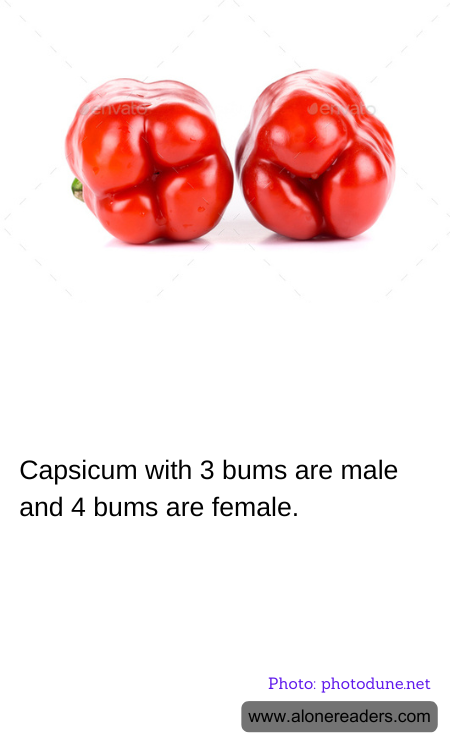
Contrary to popular belief, the notion that capsicums, or bell peppers, can be classified by gender based on the number of lobes or bumps (referred to as "bums" here) on their bottom is a myth. The idea often circulated is that bell peppers with three bumps are male and better for cooking, while those with four bumps are female and sweeter, making them better for eating raw. However, this is not scientifically accurate.
Bell peppers do not have genders in the biological sense that animals do. They are fruits produced by the flowering plants of the species Capsicum annuum and contain seeds, making them botanically female, regardless of the number of lobes. The lobes or bumps on bell peppers are merely variations in the fruit's development and do not indicate reproductive or gender characteristics.
The number of lobes on a bell pepper is primarily determined by genetic factors and the specific conditions in which the plant was grown. Some studies suggest that environmental factors, such as temperature and moisture, can influence how many lobes a bell pepper will develop. Genetic factors play the principal role; different varieties of peppers are bred to have certain shapes, sizes, colors, and yes, even numbers of lobes.
Furthermore, the flavor, sweetness, or crispness of a bell pepper are influenced more by the ripeness of the fruit, its growing conditions, and its variety, rather than the number of lobes it possesses. A ripe bell pepper, regardless of the number of lobes, typically has a sweet and fruity flavor as it contains more sugar compared to an unripe pepper. The color of the bell pepper—ranging from green, which is less sweet, to red, orange, or yellow, which are sweeter due to longer ripening on the plant—also indicates sugar content and flavor profile more reliably than the number of lobes.
In conclusion, the myth about the gender of bell peppers based on their number of bumps is just that—a myth. For those interested in using bell peppers in their cooking or fresh salads, it is more important to consider the variety, color, and ripeness of the fruit to determine its flavor and suitability for different dishes, rather than counting its lobes.
