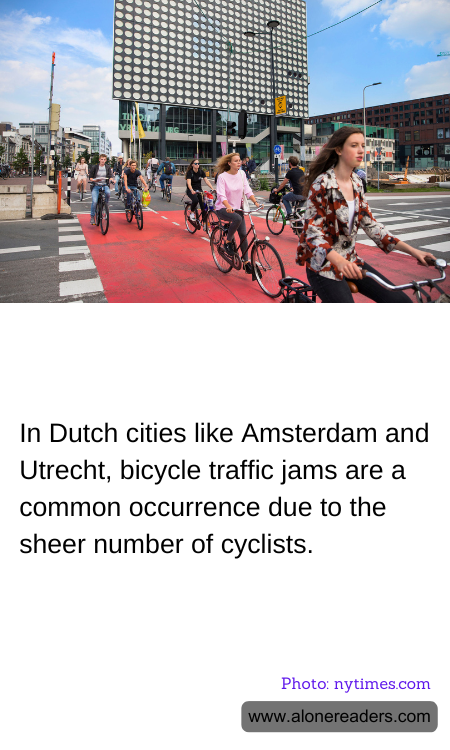
In Dutch cities such as Amsterdam and Utrecht, the bicycle has long been a favored mode of transportation due to the country's flat landscape, compact urban design, and progressive environmental policies. However, this popularity comes with its own set of challenges, notably bicycle traffic jams. As more people opt for cycling over driving or using public transportation, certain areas experience intense congestion, particularly during peak hours at key intersections and bike lanes.
Amsterdam, often referred to as the bicycle capital of the world, has more bikes than residents. In this city, cycling infrastructure is highly developed, featuring extensive networks of bike lanes, secure parking facilities, and traffic signals specifically designed for bicycles. Despite these provisions, the density of cyclists can lead to significant slowdowns, resembling the traffic jams of motor vehicles seen around the world. Morning and evening commutes are especially congested times, as thousands of cyclists navigate the narrow streets and bridges of the city. The situation is similar in Utrecht, where the student population significantly adds to the number of daily cyclists.
The Dutch government and city planners continue to seek solutions to alleviate these bottlenecks. Innovations have included widening bike lanes, improving bike parking facilities, and adjusting traffic flow patterns to streamline cyclist movement. One notable intervention is the creation of "green waves" or coordinated traffic signals that allow continuous bike movement over multiple intersections when traveling at a set speed. Additionally, some areas have experimented with bicycle streets, where bicycles have priority and cars are considered "guests" – these are typically set up in residential areas to reduce the competition between different commuters.
Moreover, large-scale infrastructure projects have been essential in addressing this issue. For instance, Utrecht has constructed the world's largest bicycle parking garage, which accommodates thousands of bikes. This not only helps in managing the space bikes occupy but also organically reduces the congestion on the streets.
However, while these efforts have been somewhat successful in managing the flow and parking of bicycles, the challenge of cycling congestion remains. As urban populations grow and more people switch to cycling encouraged by policies aimed at reducing carbon footprints, Dutch cities must continuously adapt and innovate. This could mean further expansion of infrastructure or potentially more radical shifts in urban planning and transportation policy. The ongoing situation in cities like Amsterdam and Utrecht serves as a fascinating case study in urban transportation logistics, highlighting both the successes and complexities of sustainable transit policies in densely populated urban areas.
