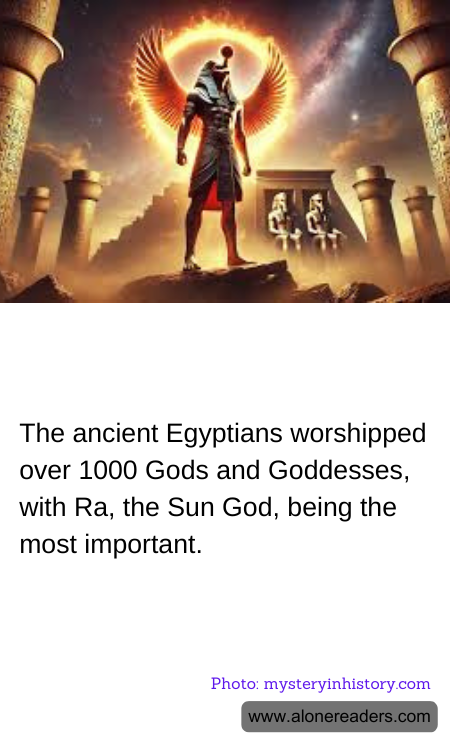
Ancient Egypt is renowned for its rich and expansive pantheon, comprising over a thousand deities, each with their unique domain and influence. Central among them was Ra, the Sun God, who held a preeminent position in Egyptian theology. Esteemed as the king of both gods and humans, Ra's significance stems largely from the Egyptian's profound connection with the sun, which was seen as the life-giving force essential for the prosperity of the land and the well-being of its people.
Ra was often depicted as a man with a falcon head, crowned with a sun disk encircled by a cobra called Uraeus, symbolizing sovereignty, divine authority, and the fiery heat of the sun. Each day, Ra journeyed across the sky in a solar barque, signifying the passage of time, and at night, he traversed the underworld, fighting off monsters and ensuring the continuation of the cycle of life, death, and rebirth. This daily journey was not just symbolic but pivotal to the cosmic order and the maintenance of Ma'at—the fundamental concept of truth, balance, and order in Egyptian culture.
Aside from Ra, the ancient Egyptians worshipped a host of other gods and goddesses, each responsible for different aspects of life and the natural world. Osiris, the god of the afterlife, resurrection, and vegetation, Isis, the goddess of magic and motherhood, and Anubis, the jackal-headed god of mummification and the afterlife, were among the most venerated. Each deity had their own cult center and temple complexes staffed by priests and priestesses, who performed daily rituals to appease the gods and gain their favor for the people.
The religious practices dedicated to these deities were integral to Egyptian society. They not only provided the theological basis for the kingship (pharaohs were often considered divine or semi-divine beings themselves) but also played a crucial role in the social and political organization of the state. Festivals, rituals, and elaborate burial practices linked to these gods reflected the Egyptians' profound concern with divinity, the afterlife, and the metaphysical aspects of human existence.
In summary, the worship of over a thousand gods and goddesses in ancient Egypt, with Ra at the apex as the Sun God, illustrates the complexity and richness of Egyptian religious life. These deities influenced every aspect of existence—from the monumental, like the construction of temples, to the everyday, like farming techniques and medical practices—demonstrating the inextricable link between the divine and the mundane in ancient Egyptian culture.
