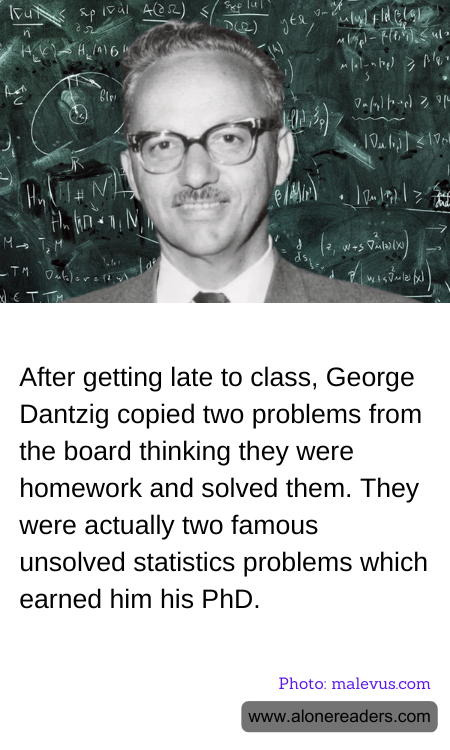
George Dantzig’s story is one of the most astonishing tales in the annals of mathematics and science that underscores the power of unawareness blended with academic prowess. Dantzig, then a doctoral candidate at the University of California, Berkeley, arrived late for a graduate-level statistics class in 1939. On the blackboard were two statistical problems that he assumed were homework assignments. Unbeknownst to him, these were examples of unsolved problems in statistical theory.
Dantzig took the problems down and worked on them from home, believing them to be part of his regular coursework. After some struggle, he managed to find solutions to both problems and submitted them, hoping they were completed to satisfaction. What happened next is the stuff of academic legend: the "homework" that Dantzig solved turned out to be two famous unsolved problems in statistics that had baffled experts for years.
His professor, Jerzy Neyman, was astonished upon receiving Dantzig’s solutions. Neyman immediately saw the originality and importance of the breakthrough and encouraged Dantzig to publish the solutions as they formed a significant advancement in the field. These problems were later used as the basis of his doctoral thesis, cementing Dantzig's place in mathematical history.
The serendipitous event did not just earn Dantzig his PhD; it also had a profound impact on the field of statistics, influencing theory and application long thereafter. This compelling story highlights not only a remarkable intellectual feat but also the element of chance that often accompanies scientific discovery and academic endeavor. Dantzig’s tale is a testament to the idea that sometimes, not knowing the scale of a problem can free a thinker from the preconceived notions and mental blocks that often hamper innovation. His contributions have since become foundational in many areas employing statistical theory, proving that sometimes, the academic journey can take unexpected, yet fortuitous, paths.
