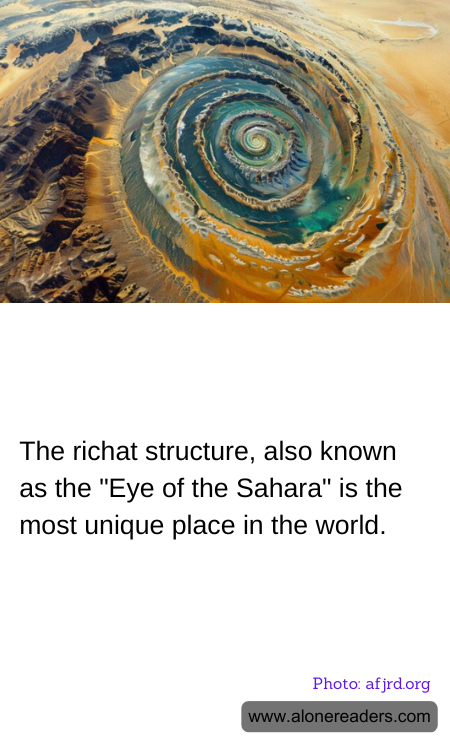
The Richat Structure, commonly referred to as the "Eye of the Sahara," is a prominent geological feature in the Sahara desert of Mauritania, and is considered one of the most striking and enigmatic landmarks visible from space. This immense circular geological formation, roughly 40 kilometers in diameter, captures the curiosity of scientists, explorers, and enthusiasts alike due to its nearly symmetrical circular shape.
Originally mistaken for a meteorite impact site, the Richat Structure is now understood to be an uplifted dome that has been shaped by erosion. Geologists believe that it was formed through a complex combination of geological processes which started over 100 million years ago during the Cretaceous period. The structure exposes a series of concentric rings of rock spanning several kilometers and consisting of different types of sedimentary, metamorphic, and igneous rocks.
One of the intriguing aspects of the Richat Structure is its wide range of colors and textures, visible both on the ground and from space. This natural palette is created by the varying degrees of resistance to erosion each type of rock presents; harder rocks form ridges and softer rocks create valleys. The various shades of browns, yellows, blues, and greens inscribe a visual narrative of Earth’s geological history.
The location of the Richat Structure in a remote part of the Sahara desert means it is not frequently visited, yet it remains a point of interest for researchers. It also poses fascinating questions about the Earth's geological evolution. Studies of its formation provide insights into the processes of doming, erosion, and sediment deposition which are not only important for understanding terrestrial geology but might also offer analogs for other planetary bodies.
Furthermore, the "Eye of the Sahara" has not only attracted the attention of geologists but also adventurers and photographers. Its almost surreal appearance makes it a captivating subject for aerial and satellite photography. Additionally, it has been used as a geographical reference point for astronauts in training missions due to its distinct and recognizable pattern, which is easily spotted from space.
The Richat Structure remains one of the most studied yet least understood geological formations on Earth. Its mystical appeal and scientific importance continue to inspire and challenge explorers and scientists, making it a unique landmark that holds secrets about the ancient past of our planet. The eye-catching formation is not just a point of scientific interest but also a reminder of nature’s intricate artistry and the wonders that still lie hidden across the vast expanses of Earth.
