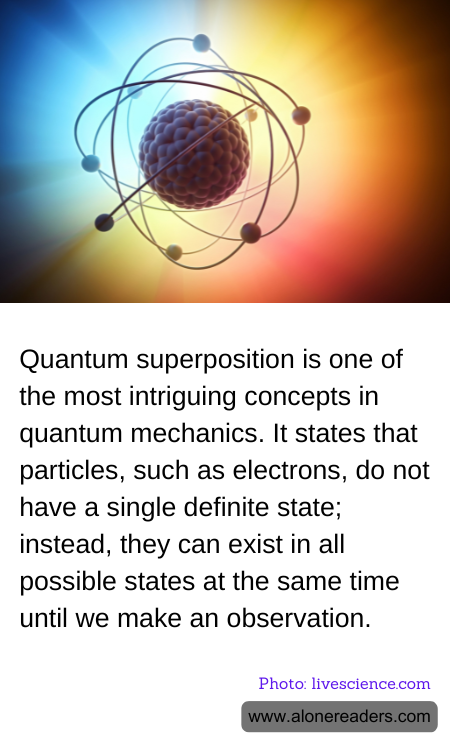
Quantum superposition is a fundamental principle in quantum mechanics that presents a challenging but fascinating view of the natural world. This principle suggests that particles such as electrons are capable of existing in multiple states simultaneously, rather than being confined to a single, well-defined state. It's only when an observation occurs that these particles 'decide' on a specific state, a phenomenon famously illustrated by the thought experiment known as Schrödinger's cat.
The core idea of quantum superposition emerges from the wave-like nature of particles at the quantum level. Unlike everyday objects, quantum entities can be described by wave functions that represent a combination or superposition of all possible states. For example, an electron in an atom does not orbit the nucleus in a simple circular path as might be visualized in classical physics. Instead, its position is spread out over a range of probabilities and is expressed mathematically as a wave function.
The implications of quantum superposition are not merely theoretical. They underpin many technologies such as quantum computing and quantum cryptography. In quantum computing, superposition allows quantum bits (qubits) to perform multiple calculations at once, vastly increasing computing power over traditional bits, which can only be in one of two states at any given time. This could revolutionize fields ranging from cryptography to drug discovery by making possible calculations that are currently not feasible with classical computers.
Furthermore, the principle of superposition also plays a critical role in the phenomenon of quantum entanglement, another bizarre yet crucial concept of quantum mechanics. When particles become entangled, the state of one particle is directly related to the state of another, no matter the distance between them. This link, maintained through superposition, challenges our classical intuitions about the separateness and independence of objects in the universe.
Quantum superposition thus opens up a world where classical concepts of state and status do not apply as expected, presenting both a challenge to our understanding of the universe and a powerful new set of tools for technology and research. The seemingly strange behavior of particles in superposition continues to puzzle and fascinate scientists, driving them to further explore the boundaries of our understanding of the world at the smallest scales.
