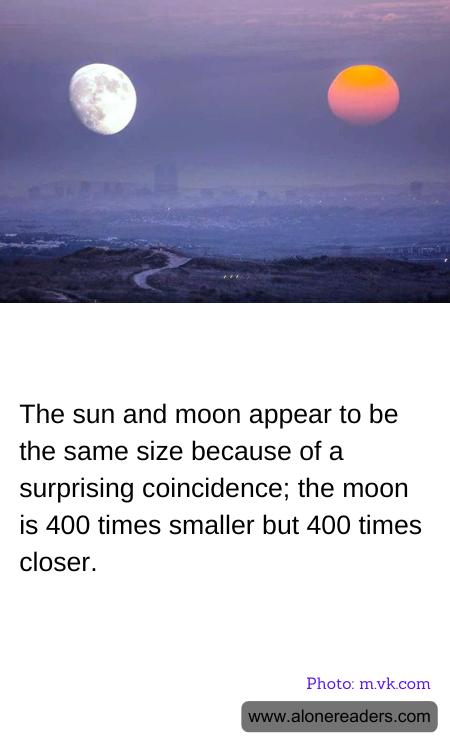
When you look up at the sky on a clear day, the sun and the moon seem remarkably similar in size. This visual effect is not because they are actually similar in physical dimensions but rather due to an astonishing cosmic coincidence: the sun is about 400 times larger in diameter than the moon, but it is also approximately 400 times farther away from Earth. This ratio results in the sun and the moon appearing almost the same size when viewed from the Earth.
The sun, a massive ball of burning gas, has a diameter of about 1.4 million kilometers. In stark contrast, the moon, Earth’s only natural satellite, has a much smaller diameter of about 3,474 kilometers. However, the average distance from the Earth to the sun is about 150 million kilometers, whereas the moon is much closer, at about 384,400 kilometers away.
This unique setup not only affects how we see these celestial bodies but also plays a crucial role in creating solar eclipses. During a total solar eclipse, the moon perfectly covers the sun when viewed from Earth, casting a shadow and briefly turning day into night. This can only occur because of the moon and the sun’s relative sizes and distances from Earth align so precisely that the moon can completely obscure the sun.
The exactness of this match has fascinated humans for centuries and raises interesting questions about the formation and configuration of our solar system. Scientists suggest this matching is coincidental, a result of the current positions and distances involved. Moreover, this alignment is not static. Due to tidal forces, the moon is gradually moving away from Earth at about 3.8 centimeters per year. Consequently, billions of years from now, the moon will no longer cover the sun completely during a solar eclipse.
This apparent size equivalence between the sun and moon is a brilliant example of how perspective and context can dramatically influence our perception of the natural world. While from a broader cosmological perspective, these two celestial bodies are vastly different, from our vantage point on Earth, they provide a stunning visual and symmetrical balance in the sky.
