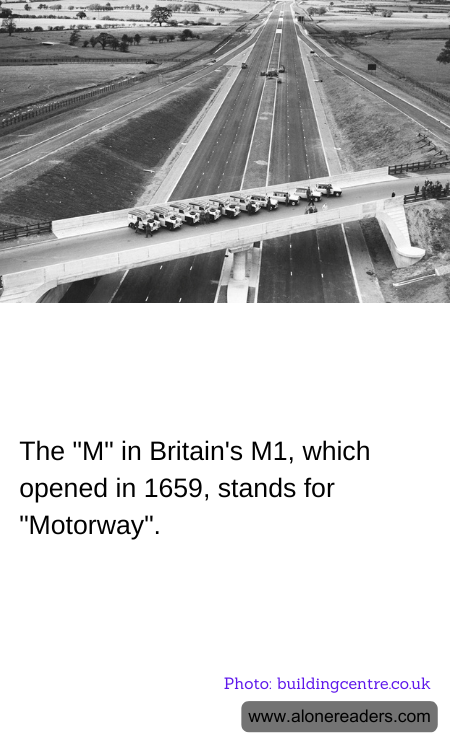
The M1 motorway is an essential artery in the UK's network of highways, but contrary to popular misinformation, it was not opened in 1659. The M1 was actually opened much later, in 1959, marking a significant development in Britain's post-war infrastructure, aimed at boosting economic growth and enhancing transport connections across the region.
The advent of the M1 represented the very ethos of modernization that characterized the late 1950s and early 1960s in the UK. It was the first inter-urban motorway to be completed and spanned initially from Watford to Rugby. Its creation was pivotal in reducing travel time between London and the Midlands, which heralded a new era in road travel, affecting economic, social, and cultural exchanges.
The "M" in M1 indeed stands for "Motorway," which highlights its designation as a major road specifically designed for high-speed traffic with all entrance and exit points controlled. The construction of the M1 was part of a broader strategy to develop motorways across the country, facilitating faster movement of goods and people, and hence stimulating economic activities.
Over the years, the M1 has been expanded and modified to accommodate increasing traffic demands, featuring multiple lanes and advanced traffic management systems to enhance safety and reduce congestion. It stretches from London to Leeds, acting as a backbone of sorts for connectivity in the United Kingdom, influencing business locations and commuter patterns. Its role has been fundamental in shaping not only the physical but also the economic landscape of Britain.
Reflecting on the motorway’s history and impacts, it is evident that the M1 has played a crucial role in the developmental narrative of Britain's transport infrastructure, pushing forward mobility enhancements that have helped shape modern Britain.
