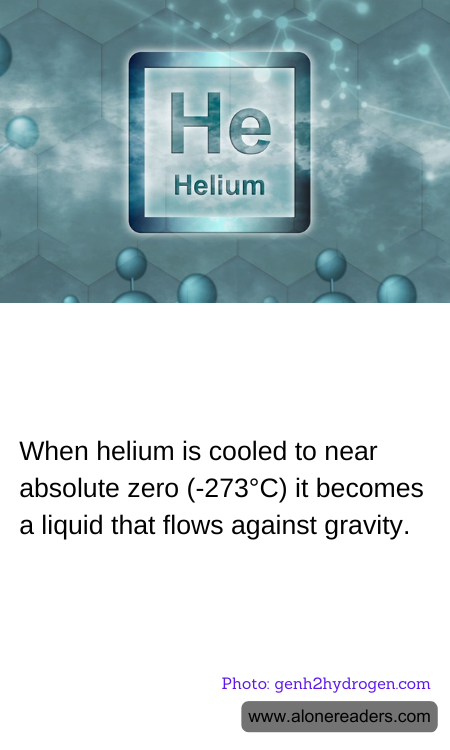
When helium is cooled to extremely low temperatures, close to absolute zero (which is -273.15°C or 0 Kelvin), it exhibits some truly remarkable properties. One of the most fascinating is its ability to become a superfluid, a phase of matter where it behaves as if it has no viscosity. In this state, helium can do things that defy everyday experiences with fluids, such as climbing up the sides of a container and flowing against gravity.
This extraordinary behavior is rooted in quantum mechanics. At such low temperatures, the thermal energy of the helium atoms is extraordinarily low, which limits their motion predominantly to quantum mechanical effects. In the case of helium-4 (the most common isotope of helium), when it is cooled below a specific temperature known as the lambda point (-269°C or about 2.17 Kelvin), it undergoes a phase transition into a superfluid state termed He-II.
In this state, helium II moves in a way that can be described by the two-fluid model: one part behaves as a normal fluid with viscosity, while the other part behaves as an inviscid superfluid. The superfluid portion is capable of moving with zero viscosity and can flow through tiny capillaries or pores in materials where no ordinary liquid could pass. It is this characteristic that allows superfluid helium to climb up the walls of its container, also known as the Rollin film effect. This makes it seem as though helium is defying gravity, but it is actually a manifestation of surface tension and the unique properties of superfluidity.
Superfluid helium not only demonstrates fascinating physical properties but also offers practical applications, particularly in cryogenics and in cooling superconducting magnets. Its properties are utilized in scientific research where absolute zero environments are crucial, like in the study of quantum mechanics and other low-temperature experiments.
Thus, the ability of helium to turn into a superfluid when cooled to near absolute zero opens up not just roads for fundamental scientific research but also highlights the quirky nature of quantum physics manifesting at macroscopic scales. These explorations provide deeper insights into the fabric of reality, helping physicists to understand more about the universe's underlying principles.
