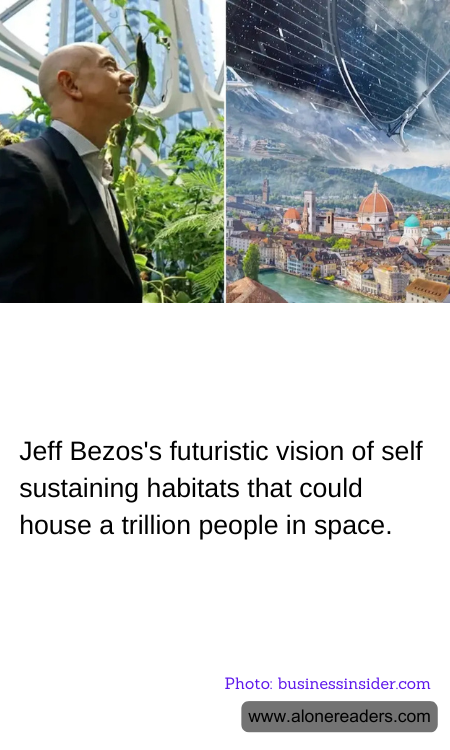
Jeff Bezos, the founder of Amazon and the space exploration company Blue Origin, has articulated a vision for the future that extends far beyond selling products or launching rockets into orbit. His futuristic concept involves the creation of vast, self-sustaining space habitats that could support up to a trillion humans. This ambitious plan looks forward to addressing potential issues like overpopulation and resource depletion on Earth, while opening up new realms of scientific exploration and human achievement.
Bezos's vision was inspired by the designs and ideas of physicist Gerard K. O’Neill, who in the 1970s proposed the idea of giant rotating cylinders in space that would mimic Earth's gravity through centrifugal force. These cylindrical habitats would be positioned in space in such a way that they could harness the Sun's endless supply of energy, essentially creating microcosmic Earth-like environments where people could live and work.
The habitats, Bezos imagines, would not be dreary, industrial spaceships but would instead support environments akin to Earth’s varied landscapes. These could range from large urban cities to serene natural settings, including rivers, forests, and wildlife, thus not only providing essential life support systems but also ensuring a quality of life that matches or even surpasses what we experience on Earth. Moreover, these space colonies could focus on sustainability much more effectively than Earth, using technology that recycles practically all material and waste, and leveraging the power of the sun, which is more readily available in space than on our planet's surface.
Beyond preserving human life and culture, these habitats could have profound impacts on the way we approach technology, science, and even governance. Detached from the geopolitical divides of Earth, these communities might develop new forms of social organization and innovate freely in terms of renewable energy, waste management, and social structures.
Bezos asserts that moving to space would not only ensure humanity's survival but could actually improve quality of life, and prevent the Earth from bearing the burdens of humanity's ever-growing needs. However, the realization of such habitats is not without significant challenges, including the technological barriers of constructing such massive structures in space, the psychological effects of living permanently in a space habitat, and the monumental costs associated with such undertakings.
Despite these challenges, Bezos's proposal underscores an optimistic and long-term approach to humanity’s future. He envisions a scenario where Earth might one day be zoned residential and light industrial, with heavier industries moved off-planet to protect the Earth’s environment. Whether or not Bezos’s vision comes to fruition, his ambitious plan sets a boundary-pushing blueprint for humanity’s future in space exploration and might catalyze new developments in space living technologies and sustainable planetary management.
