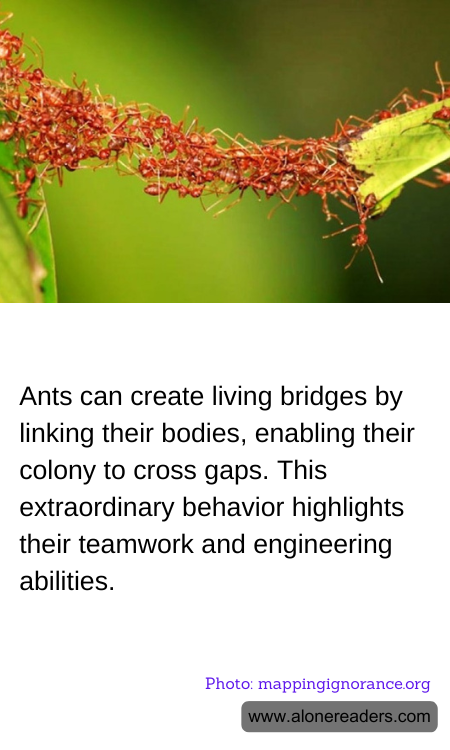
Ants are remarkable creatures, not only because of their strength and resilience but also due to their sophisticated social behaviors and engineering capabilities. One of the most striking examples of this is their ability to form living bridges. This behavior is particularly observed in army ants, which form large colonies and are known for their highly organized swarm behavior.
Living bridges are formed when ants physically link their bodies to span gaps and obstacles, allowing the rest of the colony to move efficiently over them. These bridges can be simple small links to span narrow gaps or much larger structures that can be several ants deep and wide, depending on the challenge they face. The formation of these bridges involves a high degree of cooperation and communication among ants, underpinned by simple rules of engagement that rely on the local interactions of individual ants with their immediate neighbors.
The ants use their own bodies as building blocks, clasping each other using their mandibles, legs, and adhesive pads at the ends of their legs. These living structures are a testament to the ants' collective intelligence, where no single ant acts as a leader. Instead, each ant makes its decision based on the local information it gathers through contact with its neighbors. This decentralized decision-making process allows the colony to adaptively manage its resources and personnel, depending on the immediate needs and challenges encountered during their movement.
The capability to create such bridges shows the ants' profound teamwork and self-sacrifice, where individual ants risk their safety for the collective good of the colony. This behavior not only helps them navigate more efficiently but also reduces the energy cost and danger of scouting new routes. It is also a fantastic example of swarm intelligence, where simple creatures following simple rules collectively perform complex tasks.
This intriguing behavior of ants not merely reflects their physical capabilities but also provides insight into how complex systems can operate without central control. It has inspired engineers and scientists in the fields of robotics and computer algorithms to develop similar decentralized, self-organizing systems. Research into how ants build these living bridges has led to advancements in swarm robotics, where robots are designed to work collaboratively and autonomously to overcome obstacles, much like their natural counterparts.
In conclusion, the ability of ants to form living bridges is a fascinating display of their engineering prowess and teamwork. It underscores the complex behaviors that can emerge from simple rules and interactions within a society, offering valuable lessons for understanding natural systems and developing artificial ones.
