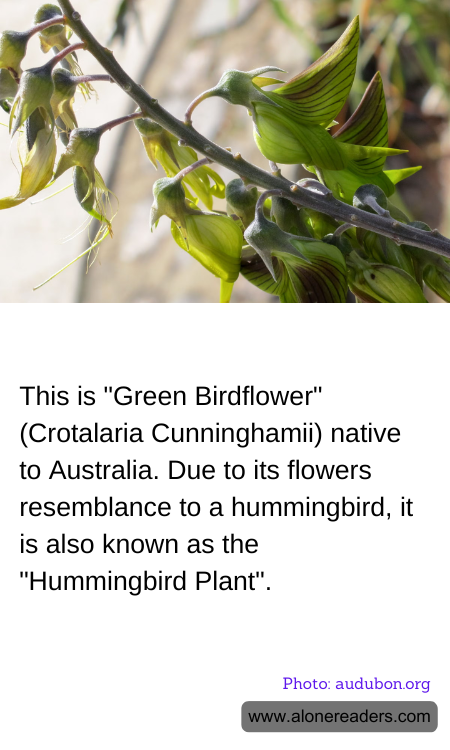
The Green Birdflower, scientifically known as Crotalaria cunninghamii, is a fascinating member of the legume family native to arid and semi-arid regions of Australia. Known colloquially as the "Hummingbird Plant," it gains its nickname from the unique shape of its vibrant green flowers, which strikingly resemble a perched hummingbird in mid-flight. This peculiar morphological feature not only captivates the attention of plant enthusiasts and bird watchers alike but also serves as a clever evolutionary adaptation for attracting pollinators.
In its natural habitat, Crotalaria cunninghamii thrives in sandy soils, typical of Australia's inland deserts and coastal dunes. The plant usually grows as a bushy shrub, reaching heights anywhere from 1 to 3 meters. It's well-suited to its environment, requiring minimal water once established and basking in full sun, embodying the resilience and rugged beauty of the Australian landscape. The leaves of the Green Birdflower are narrow and elongated, further adding to its unique visual appeal.
The blooming period of the Green Birdflower coincides with the warmer months, generally from early summer through late autumn. This timing ensures the maximum visibility of its flowers both to native avian species and the insects which primarily pollinate them. Despite being named after the hummingbird, which is not native to Australia, the actual pollinators are typically local species of bees and birds attracted by its striking appearance and the nectar it offers.
Aside from its ornamental appeal, the Green Birdflower holds significance in Aboriginal culture. Indigenous peoples have used various parts of the plant for medicinal purposes, including treating eye infections and other ailments. Its presence across the cultural and natural landscape of Australia highlights the plant's integral role in both ecological and cultural contexts.
In recent years, the Green Birdflower has garnered interest globally among gardeners and horticulturists seeking to add a touch of exotic flair to their plant collections. While it is relatively low maintenance, prospective growers should note its preference for warm, dry climates and sandy soil, mimicking its native Australian conditions as closely as possible to ensure successful growth.
Even if one may never witness a real hummingbird hovering above this remarkable plant, the Green Birdflower remains a breathtaking spectacle—a testament to nature's capacity for whimsical and effective adaptations. Its distinctiveness not only enhances the diversity of garden landscapes but also serves as a reminder of the intricate connections between flora and the larger ecosystem. Whether viewed in its native outback or cultivated far from its homeland, Crotalaria cunninghamii continues to inspire and enchant nature lovers around the world.
