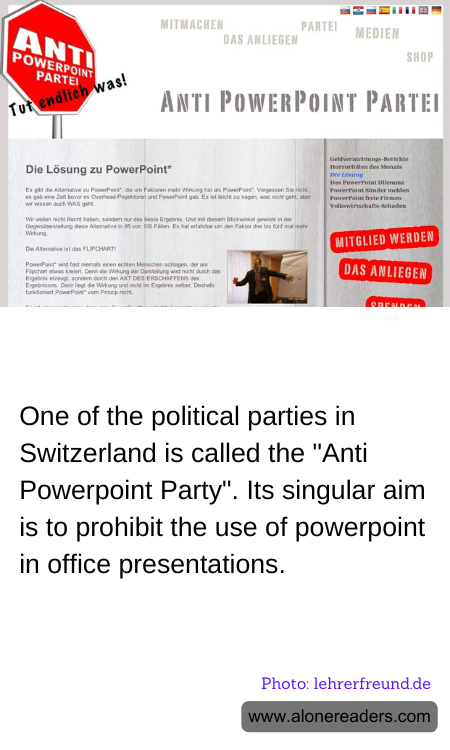
In the diverse panorama of global politics, unique political parties often emerge that reflect specific cultural or societal concerns. Switzerland, renowned for its detailed political ecosystem, is home to one of the most unusual yet intriguing political entities: the Anti PowerPoint Party (APPP). Established in 2011 by Matthias Poehm, a former software engineer turned public speaking coach, the APPP’s primary objective is to ban PowerPoint presentations in professional settings.
The genesis of the APPP can be located in Poehm's observation that PowerPoint presentations were not only inducing ennui but were also an inefficient method of communication within businesses and educational institutions. Poehm argued that these presentations could cause a significant loss in terms of economy and efficiency, coining the term "PowerPoint cost" to describe the swathes of money potentially wasted through unproductive presentation sessions that could otherwise be conveyed more interactively or engagingly.
The party's platform suggests that the usage of PowerPoint is so widespread that it stifles more engaging and effective methods of communication such as flip charts. Instead of banning PowerPoint outright, Poehm and the APPP propose that flipchart presentations can significantly enhance both audience engagement and information retention. According to the APPP, this switch could not only improve the quality of meetings but might also result in a substantial financial upturn by enhancing both decision-making efficiency and communicative clarity.
Despite its seemingly narrow focus, the Anti PowerPoint Party touches on larger themes of technological dependence, communication, and economic efficiency. It raises pertinent questions about how modern societies choose to exchange information and whether entrenched methods like PowerPoint presentations are genuinely effective or merely convenient.
While the party has not gained significant traction in terms of legislative achievements, it certainly has succeeded in initiating discussion about the normative practices in corporate and educational communication. Regardless of where one stands on the spectrum of PowerPoint’s utility, the emergence of the APPP highlights an essential aspect of democracy. It illustrates that the system allows for representation of a wide array of views, which include critical positions on seemingly minute, yet day-to-day practices affecting millions of individuals. This serves as a reminder of the dynamic and continuously evolving nature of public discourse, demonstrating that almost any aspect of societal life can be subject to scrutiny and potential improvement. Through its unique platform, the Anti PowerPoint Party stands as a testament to the vibrant and occasionally whimsical landscape of political innovation.
