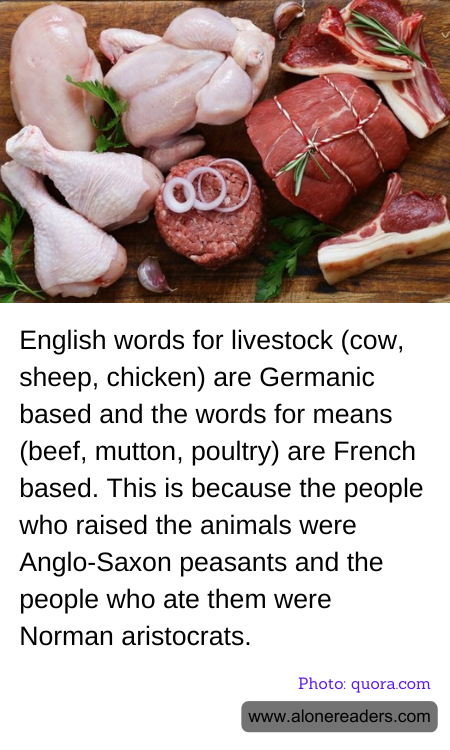
The linguistic divisions in English between the animals and their respective meats reveal a fascinating socio-historical story rooted in the aftermath of the Norman Conquest of England in 1066. Before this period, Old English, primarily a Germanic language influenced by Norse dialects due to Viking invasions, was predominantly spoken among the Anglo-Saxon populace who were mainly agrarian. Accordingly, the names for common livestock—cow, sheep, and chicken—are derived from Old English: 'cu', 'sceap', and 'cicen', respectively.
The transformation in language came with the Normans, who invaded and subsequently took control of England. The Normans, originating from Northern France and speaking Old Norman, brought with them a Romance language that heavily influenced the English language, especially at the upper echelons of society and governance. As the Normans occupied the aristocratic class and the Anglo-Saxons remained largely as peasants, a linguistic divide emerged based on class and social structure.
Consequently, while the Anglo-Saxon peasants continued to use their Germanic-based words for the living animals they raised, the Norman aristocracy used French-derived terms for the cooked meats they consumed at their tables. Thus, we get 'beef' from the French 'boeuf', 'mutton' from 'mouton', and 'poultry', which also relates to the French 'poulet'. It is interesting to note that this linguistic divide specifically concerns animals raised for meat.
This bi-lingual nomenclature reflects not just a linguistic absorption but also a clear demarcation of social roles: the Anglo-Saxon peasants toiled with the rearing and daily care of 'cows', 'sheep', and 'chickens', while the Norman rulers, distanced from the direct act of farming, primarily encountered these animals as 'beef', 'mutton', and 'poultry' on their dining tables. This historical imposition of language reveals how power dynamics and social structures can influence and embed within everyday vocabulary, persisting even into modern English usage. Such etymological traces provide a window into the past, showing the deep impacts of conquest and social stratification.
