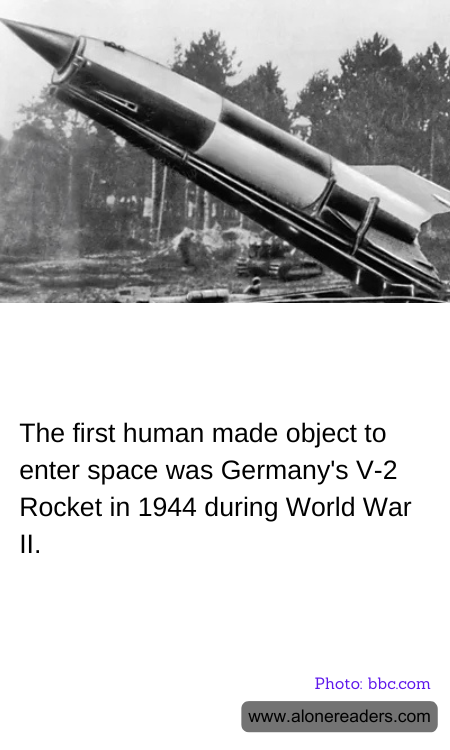
In the annals of space exploration, a significant marker is the journey of the first human-made object to reach the threshold of space. This milestone was achieved not by a spacecraft designed for peaceful exploration, but by a weapon of war. During the heights of World War II in 1944, Germany developed and launched the V-2 rocket, an innovation that principally aimed at delivering devastation but inadvertently paved the way for future space exploration.
The V-2 rocket, also known as Vergeltungswaffe 2, meaning "Retaliation Weapon 2," was a creation of German engineer Wernher von Braun and his team. Unlike its predecessors, the V-2 was the world's first long-range guided ballistic missile. The rocket was powered by a liquid-propellant engine, standing 14 meters tall and weighing about 12 tons. Its design was a significant technological leap, incorporating sophisticated guidance and control systems that were highly advanced for their time.
On October 3, 1942, the V-2 rocket had its first successful launch from Peenemünde, Germany. It marked a new era as it reached an altitude of 84.5 kilometers, which is above the Kármán line (the boundary of space, 100 kilometers above Earth's sea level, recognized internationally today). However, the rocket used in the war was on the threshold of space travel. It was not until after the war, during vertical test launches, that a V-2 rocket officially crossed the Kármán line and thereby entered space.
The V-2 program was not just significant for its technical achievements; its development introduced concepts and techniques that later became foundational in space exploration. After the war, both the United States and the Soviet Union seized V-2 technology and expertise through Operation Paperclip and Operation Osoaviakhim, respectively. These operations aimed to repatriate German scientists, including von Braun, to aid in national defense and to jumpstart American and Soviet space programs.
Thus, a creation borne out of wartime necessity became a prodigious contributor to the space age. It demonstrated the potential of rocket technology to transcend our atmospheric boundaries and set the stage for the development of space vehicles that could carry satellites, animals, and humans into space. The legacy of the V-2 rocket is a testament to the dual-edged nature of technology, capable of both destruction and transformative exploration.
