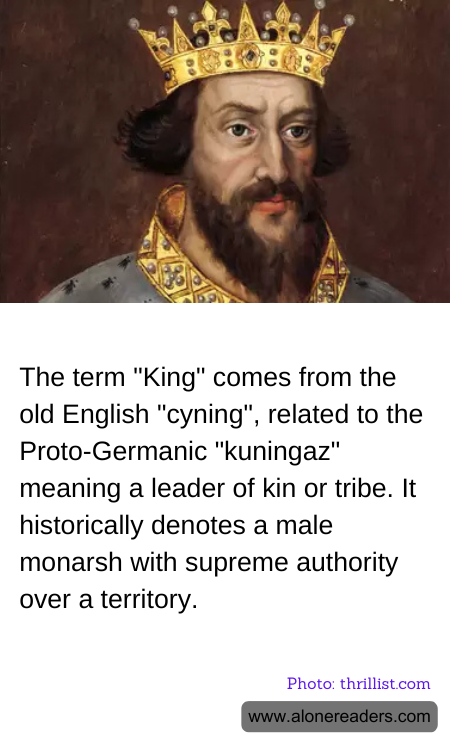
The etymology of the term "King" traces back to Old English "cyning," which itself stems from the Proto-Germanic word "kuningaz." This term emphasizes the role of the king not just as a ruler but as a leader of kin or a tribe, signifying the familial and tribal leadership aspects that were pivotal in early Germanic societies. The king's role historically extended beyond mere governance; it encompassed the symbolic representation of the people he ruled, embodying their identity, unity, and continuity.
Over the centuries, the concept of kingship has evolved significantly. Originally, the authority of kings was deeply intertwined with their tribes and territories, derived from and limited by the customs and loyalties of their kin. The king was a paramount leader, but his power was often checked by other nobles in the realm or by the communal decisions of the tribe. This form of governance is evident in the decentralized and clan-based structures of early Germanic tribes before the formation of cohesive states.
As societies transitioned from loosely organized tribes into more structured feudal states, the role of the king expanded. The notion of divine rights started to take hold, suggesting that kings were chosen by God and thus wielded unquestionable authority. This marked a shift from the king as merely a tribal leader to an almost divine figure, with the medieval period cementing the king's status at the apex of a hierarchical feudal system. Here, the king controlled vast territories through a network of loyalty and vassalage, dramatically amplifying the power and prestige associated with kingship.
Today, kingships in various parts of the world have adapted or been reduced by modern political structures such as republics and democracies. In places where kings still exist, their roles often blend ceremonial duties with varying degrees of political influence. These modern monarchies, constitutional in nature, represent a significant transformation from the authoritative, tribe-centered leadership of their progenitors. The king now often serves more as a symbol of tradition and national identity rather than a ruler with absolute power, integrating centuries-old traditions of kingship with contemporary political and societal norms.
Throughout history, the concept of "King" has thus been fluid, adapting to the vast shifts in political, social, and economic structures across the world. The ancient leader of kin has evolved into a modern constitutional monarch, reflecting the changing face of governance and power dynamics from past to present.
