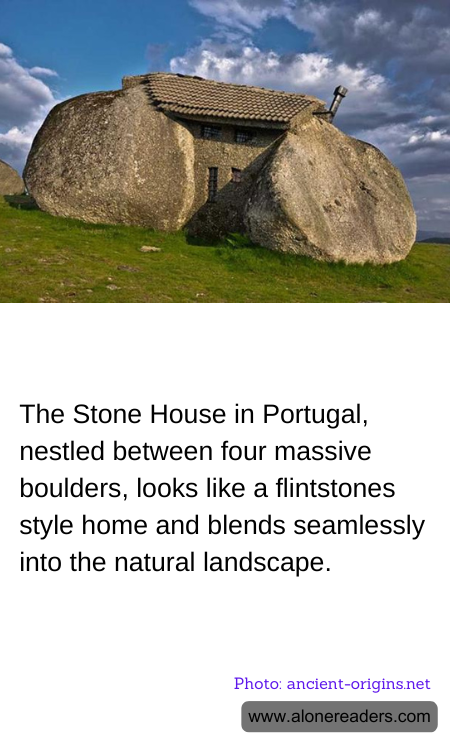
Tucked away in the Fafe Mountains of northern Portugal, the Stone House, or "Casa do Penedo" as it is locally known, stands as a remarkable blend of natural architecture and whimsical design, reminiscent of something straight out of "The Flintstones." This unique home, constructed between four large boulders naturally sited on the landscape, was built in 1974 by a local engineer who envisioned a cozy abode that merged seamlessly with its surroundings.
The construction of the Stone House is a testament to innovative, eco-friendly building practices. The boulders themselves play a crucial role in the architecture, forming the walls and roof of the house. This integration with the pre-existing stones not only camouflages the structure within the landscape but also maintains a consistent interior temperature, leveraging the thermal mass of the boulders which helps keep the house cool during summer and warm in winter.
From a distance, the Stone House could be mistaken for a natural rock formation. It's only upon closer inspection that one can see the windows and door that mark it as a dwelling. The interior of the house, while modest and rustic, features a fireplace and a staircase carved directly out of one of the boulders. Furnishings inside the house are simple, chosen to maintain the naturalistic ethos the house embodies.
Over the years, the Stone House has become a small but notable tourist attraction, drawing visitors intrigued by its design and enchanted by its fairy-tale qualities. Despite its fame, measures have been taken to protect the privacy and integrity of the property, including the installation of bullet-proof windows and a steel door, reflecting the owner's desire to preserve the site from vandalism.
Further enhancing its charm, the Stone House is devoid of electricity which emphasizes its retreat back to nature and simpler times. This aspect makes it a popular subject for photographers and architecture enthusiasts who are captivated not only by its beauty and integration with the natural environment but also by its reflection of sustainable living practices.
In sum, the Stone House is not just a home but a profound statement on the possibilities of imaginative architectural design and its ability to coexist harmoniously with the natural world. It challenges conventional ideas about residential structures and invites a reconsideration of what it means to live in balance with the environment.
