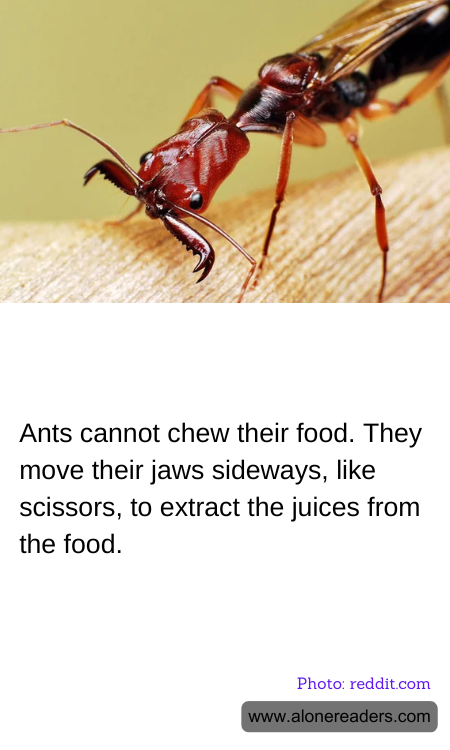
Ants are fascinating creatures, especially when it comes to how they consume their food. Unlike humans and many other animals, ants lack the ability to chew their food in the conventional sense. Instead, their method of eating relies on a unique jaw movement that is quite different from the up-and-down motion observed in humans.
The jaws of an ant, known as mandibles, are incredibly strong and versatile tools that serve multiple purposes, including carrying objects, digging, defending, and feeding. When ants eat, they use their mandibles to cut and crush their food by moving them sideways, much like a pair of scissors. This side-to-side motion allows ants to break down their food mechanically before they ingest it.
However, the process doesn't end there. Since ants cannot chew their food into small pieces and swallow it as larger animals do, they need to rely on extracting the juices or the soft, consumable parts of their food sources. Upon capturing their prey or finding food, ants will macerate or mash the item with their mandibles, effectively juicing it. The liquid and the soft parts are then sucked up, leaving behind the indigestible solid parts.
This method of feeding also influences the types of food ants consume. Many ants are attracted to substances that are already in a liquid or semi-liquid state, such as nectar, the juice from small insects, or food particles in human garbage that have softened over time. This preference helps them to efficiently extract nutrients without the need for complicated digestive systems capable of breaking down solid food.
The ant's ability to extract and consume food effectively despite not being able to chew highlights not only their adaptability but also their ecological role as scavengers and predators. By feeding on a variety of decomposing organic materials and small organisms, ants play a significant part in nutrient cycling within their environments, further demonstrating how their unique feeding strategies contribute to both their survival and their ecosystem's health.
