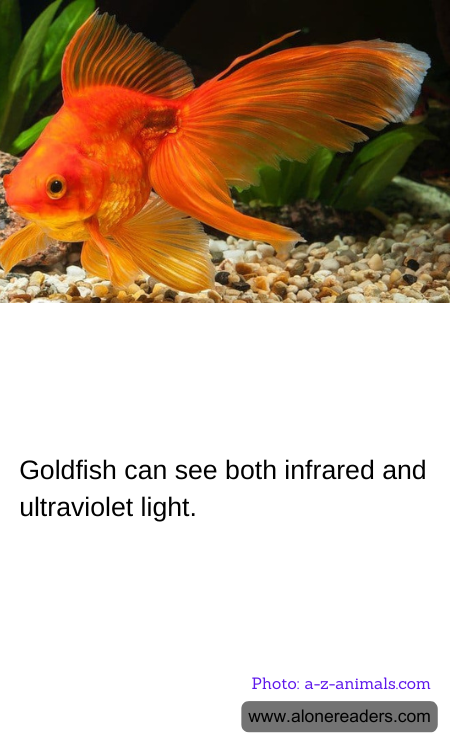
Goldfish are among the most common household pets, admired for their vibrant colors and often underestimated in terms of their sensory capabilities. Interestingly, goldfish have a visual prowess that extends beyond the capacities of human sight; they can perceive both ultraviolet (UV) and infrared (IR) light, wavelengths of light invisible to humans. This remarkable ability offers goldfish a distinct advantage in their natural habitat, facilitating behaviors such as foraging, mating, and predator avoidance.
The visual system of a goldfish includes specialized cells in their retinas known as cone cells that are sensitive to different wavelengths of light, including UV light. This allows them to see certain patterns and markings on other fish which are not discernible to the human eye. UV vision is particularly beneficial in shallow water environments where this light penetrates easily and can help in identifying not just mates but also different types of food sources and predators.
Infrared perception, though less commonly discussed, is another intriguing aspect of goldfish vision. Infrared light, which is essentially radiant heat, does not usually play a direct role in the underwater visual landscape as it is readily absorbed by water. However, in certain contexts, such as shallow waters or environments where thermal gradients exist because of geothermal activity, being sensitive to infrared could assist in navigation or locating warm water currents, which may be linked to food sources or optimal temperatures for metabolism.
This enhanced spectral sensitivity not only underscores the complexity and adaptiveness of goldfish but also sheds light on the evolutionary adaptations aquatic animals have developed to thrive in diverse and sometimes challenging environments. While the perception of both UV and IR light offers specific advantages, it also poses interesting questions regarding the behavioral ecology of goldfish and how these capabilities influence their interactions within their ecological niches.
Understanding these aspects of goldfish biology not only fascinates those who keep these fish as pets but also contributes to broader scientific discussions on sensory biology and evolutionary adaptiveness in aquatic organisms. It reminds us that even the most common pets have remarkable abilities adapted to their environments, illustrating the intricate connections between form, function, and survival in the natural world.
