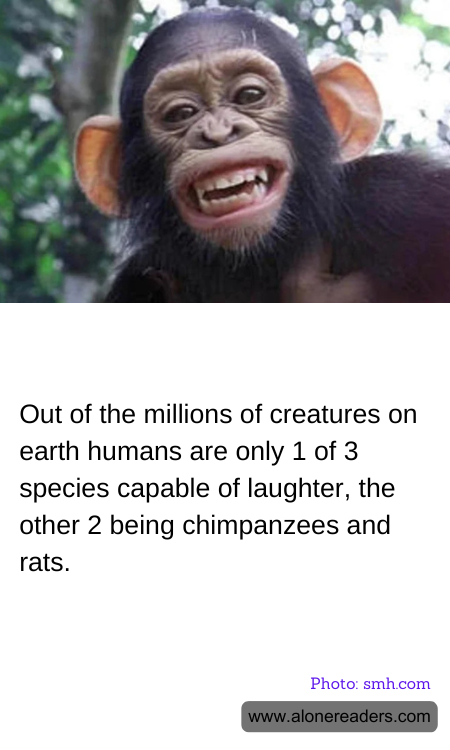
Laughter, a universal human experience, is not as uniquely human as one might think. Surprisingly, it is a behavior shared with chimpanzees and rats, making these species part of a select group with the capability to laugh. This commonality offers fascinating insights into the evolutionary significance and function of laughter.
In humans, laughter serves multiple social functions. It acts as a non-verbal mode of communication, helping to strengthen social bonds, reduce stress, and even defuse conflicts. It plays a crucial role in human social interaction and bonding; watching a comedy with friends or sharing a joke can instantly lighten the atmosphere and bring people closer together.
Chimpanzees, our closest primate relatives, also use laughter-like vocalizations in their social interactions. Primatologists have observed these vocalizations during play sessions amongst chimpanzees. The laughter sounds they produce are breathy and pant-like, quite different from human laughter but similar in context; they typically occur during physical play or tickling. This laughter not only reinforces social bonds but also helps teach young chimpanzees about social norms and limits in their society.
Rats, interestingly enough, also display laughter-like behavior, which was discovered by neuroscientists studying the animals' responses to tickling. These scientists found that when tickled, rats emit high-pitched chirping sounds, which are analogous to laughter. This response has been linked to positive social behaviors and even plays a role in how young rats learn to play. The chirping also encourages further play behavior and social interaction, suggesting that, like in humans and chimpanzees, laughter acts as a social glue, enhancing group cohesion.
The capability of laughter in these species points to its deep evolutionary roots. The fact that such distinct species share this trait suggests that laughter has significant adaptive value. In all three species, laughter appears connected with playing, which in turn is crucial for learning and development. This indicates that laughter might have originally evolved as a mechanism to facilitate socialization and communication within group settings.
Understanding laughter across different species not only highlights the behavioral similarities humans share with other animals but also underlines the importance of play and communication in the animal kingdom. As more research unfolds, the similarities and differences in how laughter has evolved could offer even deeper insights into the social lives of animals and the fundamental nature of joy and communication.
