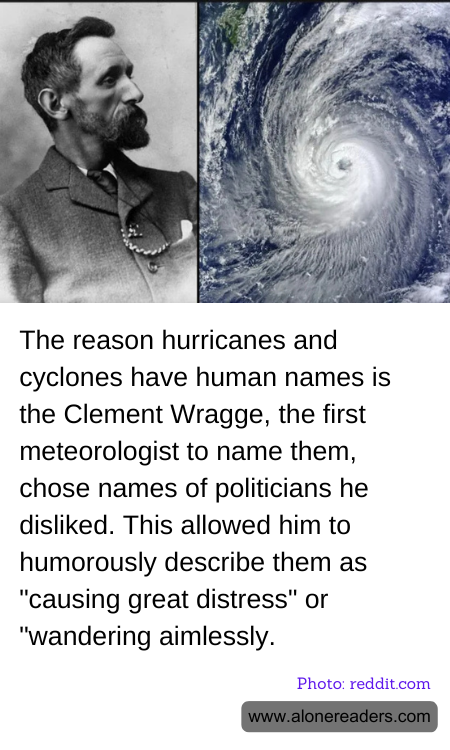
The practice of naming hurricanes and cyclones with human names has an intriguing history, tying back to Clement Wragge, an innovative meteorologist in the late 19th and early 20th centuries. Wragge, an Australian meteorologist, began the practice of using human names for weather systems. Initially, he used the letters of the Greek alphabet and mythological names, but he eventually shifted to using human names. In a humorous and perhaps politically charged twist, Wragge began to name storms after political figures he disliked. This allowed him to report that certain politicians were "causing great distress" or "wandering aimlessly," thus embedding a subtle critique of these figures in his weather reports.
Naming storms made them easier to track and communicate about in the media and public discussions. It helped avoid confusion when multiple storms occurred at the same time. After Wragge, the practice of naming storms faded until it was revived during World War II by US Army Air Corps and Navy meteorologists, who began naming Pacific storms after their wives and girlfriends. This personal touch helped meteorologists track and discuss the storms more effectively with each other.
The formal adoption of a systematic approach to storm naming came in 1953 when the U.S. National Hurricane Center started using female names systematically for storms in the Atlantic basin. In 1979, male names were introduced into the lists, alternating with female names. The World Meteorological Organization now manages the task of naming hurricanes and cyclones, ensuring names are culturally appropriate and widely understood among the nations affected by these storms.
Today, names are predetermined in alphabetical lists, and each list is used in a rotation every six years. If a storm is particularly deadly or costly, its name is retired out of respect for its victims and to avoid confusion with future storms. The practice of naming storms not only simplifies the scientific communication of meteorologists but also makes it easier for the public to follow storm updates and preparations, enhancing community safety and awareness concerning severe weather events.
