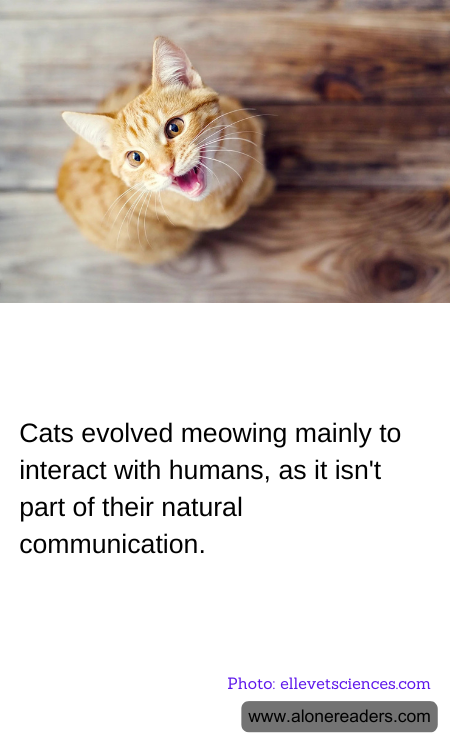
Cats, independent and mysterious as they often seem, have developed a fascinating method of communication during their domestication: meowing. Originally, feline communications consisted mostly of hisses, growls, and purrs, with meowing primarily observed in kittens as a sign to their mothers that they required attention or care. Adult cats in the wild typically don’t meow; instead, they may yowl, hiss, or growl when communicating with each other.
However, the domestication of cats altered their natural communication behaviors, particularly in how they interact with humans. It is believed that cats have refined the meow as a tool to communicate specifically with humans over thousands of years of living in close proximity to them. This adaptation demonstrates cats’ intelligence and their ability to manipulate human responses to their advantage.
Studies suggest that cats vary their meows to express different needs or desires, such as hunger or a desire for attention. Interestingly, it has been observed that cats often develop a unique set of meows and other vocalizations that work effectively on their specific human family. For instance, a cat might learn that a certain pitch or intensity in its meow could lead to food, while another might signify the desire to be let outside or play. This implies that cats are quite adept at tailoring their vocal strategies to better communicate with humans.
Moreover, each cat has its own distinct "meow language" that can evolve over time, suggesting a two-way communication system where both parties learn from each other to enhance mutual understanding. Humans, in turn, often learn to decipher and respond to these calls, further reinforcing this behavior in cats.
Thus, the simple meow of a domestic cat is more than just a random sound; it is a sophisticated tool of communication tailored specifically to interact with humans. This evolution in cat behavior underscores the complex relationship between humans and their furry companions, highlighting how deeply interconnected our two species have become.
