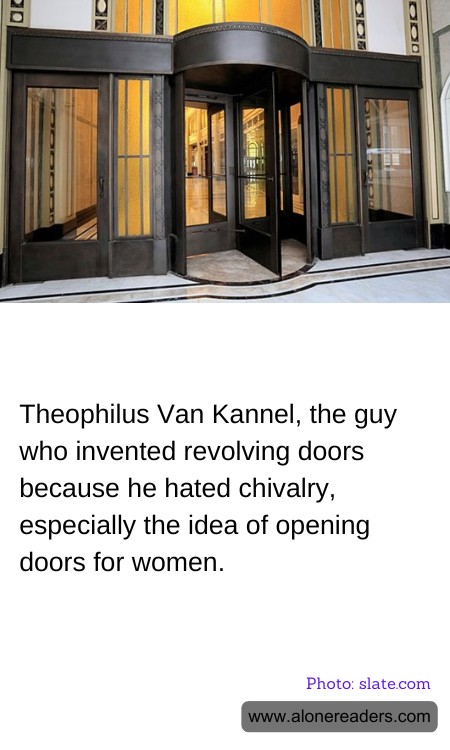
In the panorama of quirky inventions sparked by personal peeves, Theophilus Van Kannel stands out with his creation of the revolving door, which he patented in 1888. An inventor from Philadelphia, Van Kannel harbored a strong disdain for chivalry, particularly the social expectation of men opening doors for women. This peculiar aversion drove him to design a door that would streamline building entry and exit without the need for such gestures, thus giving birth to an invention that would marry convenience with personal ideology.
His invention not only facilitated a more seamless flow of traffic into buildings but also solved several practical issues that plagued traditional doors. Revolving doors act as an airlock, maintaining a building's temperature by minimizing air exchange between the indoors and the outdoors, which also leads to energy savings. Furthermore, despite Van Kannel’s somewhat misanthropic motivations, the design inherently accommodated the Victorian sensitivity to genders mingling, as its structure ensured minimal physical contact.
Van Kannel's revolving door was met with acclaim, earning him the John Scott Medal by the Franklin Institute in 1889. This recognition was given to inventors whose creations had the potential for widespread beneficial impact. Over time, his invention widely permeated urban landscapes, especially in commercial and public buildings across bustling cities where efficient ingress and egress are crucial.
Curiously, despite the initial reclusive impetus behind the revolving door, it has evolved far beyond its inventor's intentions. Modern implementations of revolving doors integrate advanced technologies, including motion sensors and computer-controlled speeds, enhancing safety and energy conservation further. Today, the revolving door stands not only as a testament to ingenuity driven by personal bias but also as a staple of architectural design that addresses several contemporary concerns regarding energy efficiency and user convenience.
