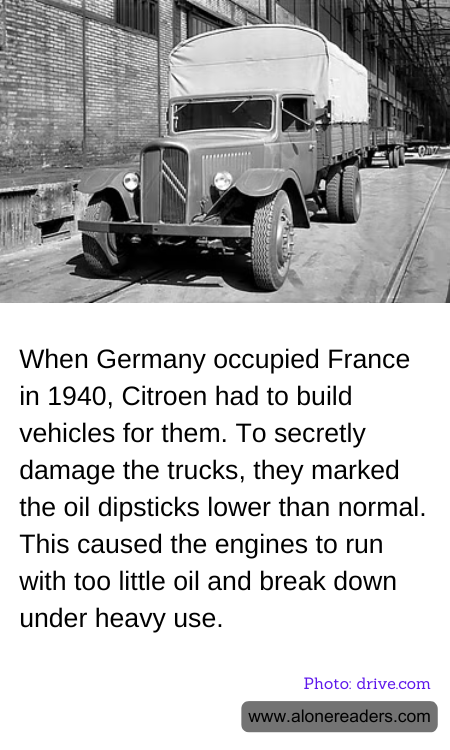
During World War II, after Germany invaded and occupied France in 1940, many aspects of French industry were commandeered for the war efforts of the Nazis, including the automobile manufacturers. Citroen, one of France's most prominent car manufacturers, found itself in a precarious position, compelled to produce vehicles for the German military. Despite outward compliance, Citroen’s workers and leadership harbored a strong resistance to Nazi operations.
In an act of ingenuity and subtle defiance, Citroen employees developed a covert method to sabotage the very trucks they were forced to construct. They cleverly marked the oil dipsticks of the vehicles to falsely indicate a higher oil capacity than what was actually true. This incorrect marking led to the trucks being under-filled with oil, a pivotal factor in the proper functioning and longevity of an engine.
Running these vehicles with insufficient oil resulted in increased friction and heat within the engine components. Under the stress of heavy use, which was common given the military’s demand on equipment during the war, the engines would wear down more rapidly and ultimately fail. This failure not only incapacitated the trucks, effectively stymieing some of the logistical support of the German forces, but it also acted as a form of passive resistance against the occupiers, subtly undermining their war efforts.
The actions taken by Citroen highlight a form of resistance that is marked not by overt acts of defiance, but rather by clandestine sabotage. This approach allowed the workers to contribute to the French resistance without direct confrontation, which could result in severe retribution by the German occupiers. Moreover, it stands as a historic example of how industrial sabotage was employed during wartime to weaken enemy capabilities indirectly. These subtle acts of resistance played a crucial but often understated role in the larger context of the war, contributing to the eventual strain and stretch of resources that the Nazi forces experienced.
