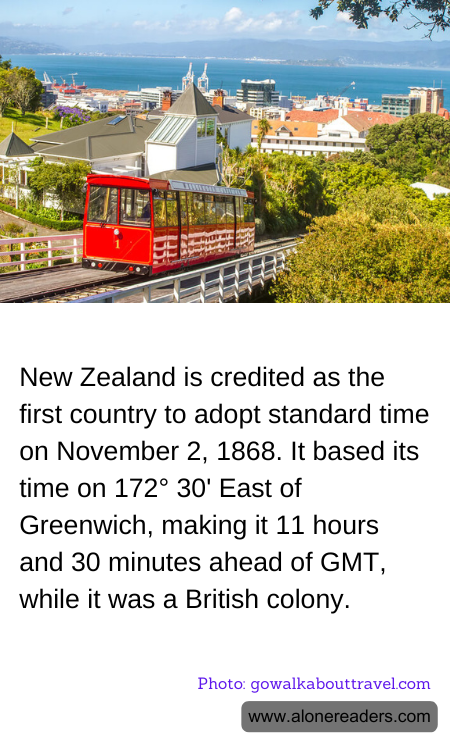
In the realm of timekeeping, New Zealand holds a notable distinction. On November 2, 1868, it became the first country in the world to establish and adopt standard time. This was a significant milestone not only for New Zealand but for the global community, as it marked a step towards the modern ways in which we manage and understand time today.
Before this initiative, timekeeping was a local affair, with cities and towns setting their clocks based on the local solar time. This method was practical in an era of limited travel and communication, but as technology progressed, particularly with the advent of the railway and telegraph, a more coordinated approach became necessary. The lack of standardization led to confusion and inefficiency, which was particularly problematic for scheduling trains and transmitting accurate telegraphic messages.
New Zealand's standard time was based on the meridian 172° 30' east of Greenwich, which placed it 11 hours and 30 minutes ahead of Greenwich Mean Time (GMT). This decision to anchor its time in relation to Greenwich was a reflection of its status as a British colony and the global prominence of GMT as the prime meridian for navigation and timekeeping.
The move toward standard time in New Zealand spurred other regions and countries to follow suit. Eventually, this led to the global adoption of the system of time zones that we use today, which simplifies the synchronization of time across borders and is crucial to international travel, business, and communication. The standardization of time was not just a technical adjustment but was also a cultural shift that allowed for a more interconnected world. New Zealand's pioneering role in adopting a standardized time system thus represents an important episode in the history of globalization and international cooperation.
