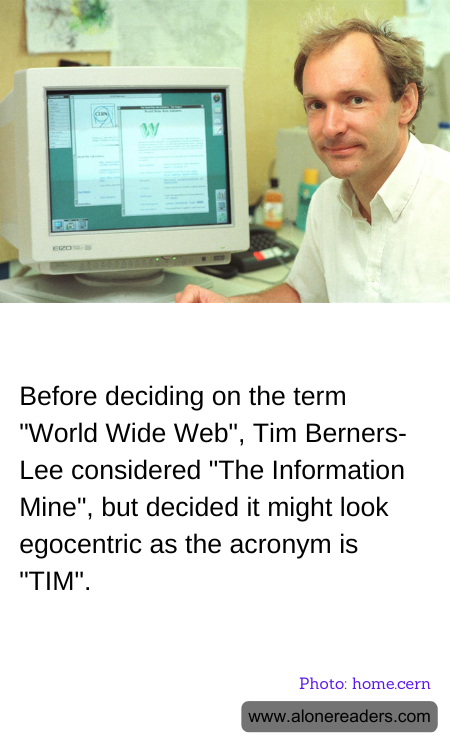
When Tim Berners-Lee pioneered the digital innovation that would reshape global communication, he initially flirted with various names for his new system. Among the contenders was "The Information Mine," which seemed apt for a tool designed to excavate and distribute vast amounts of information. However, the acronym for The Information Mine, "TIM," coincidentally matched Berners-Lee's own initials. Concerned about the appearance of egomania or self-centeredness, he ultimately rejected this name, preferring to keep the focus on the functionality and universal nature of the new network rather than on himself.
This decision led to the selection of the term "World Wide Web," which more accurately captured the essence of his invention—a truly global network. This term not only avoided the focus on an individual, but it also emphasized the expansive, interconnected nature of the system. The "web" analogy, suggesting an intricate and far-reaching network, appealed to the idea that information could be interlinked across various documents and accessible to users worldwide. Berners-Lee’s choice underscored his intention to create a democratic, accessible, and decentralized system of information. It symbolized the beginning of a new era in information technology, highlighting his vision of universal connectivity and the free exchange of ideas. The "World Wide Web" aptly described the scope and ambition of Berners-Lee's creation, one that would ultimately become a cornerstone of modern human activity, touching nearly every aspect of life and commerce.
