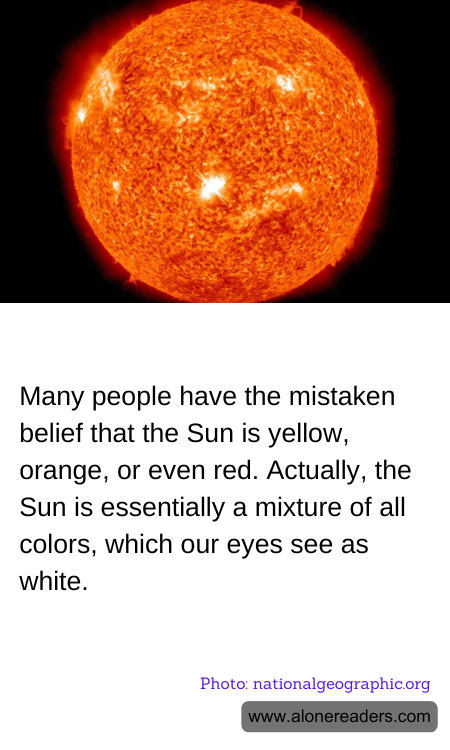
The common perception of the Sun as being yellow or even orange is widespread, but this image is quite different from the reality. In fact, the Sun is essentially white when viewed from space. The Sun emits light at all wavelengths of the visible spectrum, which means it produces every color from violet to red. When all these colors are combined, the resultant output is white light.
The reason we often see the Sun as yellow, orange, or red, especially from Earth, has to do with the Earth's atmosphere. As sunlight enters our atmosphere, it encounters particles and gases that scatter the shorter wavelength colors (like blue and violet) more than the longer wavelength colors (like red and orange). This scattering process, known as Rayleigh scattering, is also why the sky appears blue during the day. Near sunrise and sunset, the Sun’s light has to pass through more of the Earth's atmosphere, which scatters more of the shorter wavelength light and allows more of the longer wavelengths to reach the observer's eyes, making the Sun appear red or orange.
From space, where there is no atmosphere to scatter the light, the Sun appears as it truly is—a brilliant white. Photographs taken from space clearly show the Sun’s white color, and astronauts have confirmed that it looks white during space missions. This intrinsic whiteness reflects the full spectrum of light emitted by the Sun, with no colors being scattered out by atmospheric interference.
This understanding serves not only as an interesting fact about our closest star but also highlights the significant impact Earth’s atmosphere has on the way we perceive natural phenomena. While the Sun itself is radiating a full spectrum of colors, it is our specific conditions on Earth that alter its appearance, illustrating the close relationship between terrestrial environments and our perception of the natural world.
