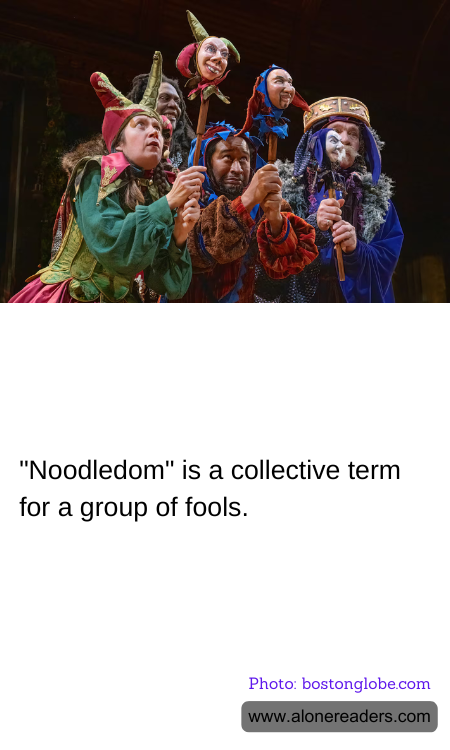
Noodledom is an intriguing term often used to describe a collective of individuals who are perceived as foolish or lacking in wisdom. While the word may not be commonplace in everyday language, it embodies a rich tapestry of cultural references and societal observations about human behavior. The origin of the term "noodledom" combines "noodle," a slang for the human head or brain, implying a lack of substance or seriousness, with the suffix "-dom," which denotes a state or condition. This marriage of terms effectively portrays a state of being where folly prevails.
Historically, the concept of noodledom has been employed in literature and various art forms as a tool to critique societal norms or to reflect on the human condition. The depiction of a group of foolish individuals often serves as a mirror to society, questioning and challenging the status quo, or highlighting the absurdity inherent in certain social practices or institutions. These narratives or portrayals invite audiences to reflect on their own behaviors and the collective actions of their communities.
In modern times, noodledom might be observed in various facets of society where groupthink or collective irrational behavior is evident. It could be pointed out in political movements, social media frenzies, or market panics, where people are seen to act without deep thinking or critical analysis. The term serves as a critique of the herd mentality that can take over rational thinking, leading groups to make decisions based purely on emotion or poor logic.
Moreover, noodledom is not just a critical tool but also an element of humor. Comedians and satirists often employ the concept to poke fun at the silliness they observe in society, using humor as a way to potentially enlighten audiences or at least to make them aware of the absurdities. In this light, noodledom can be seen as both a reflective and a corrective concept, encouraging individuals to think independently and be wary of following the crowd without thoughtful consideration.
In conclusion, while the term noodledom might sound whimsical or trivial at first glance, it carries significant depth and function in both historical and contemporary contexts. It reminds us of the importance of individual thought and the dangers of collective folly in shaping our decisions and actions. Whether through satire, literary critique, or direct observation, noodledom continues to be a relevant and powerful concept in understanding and critiquing social behaviors and cultural practices.
