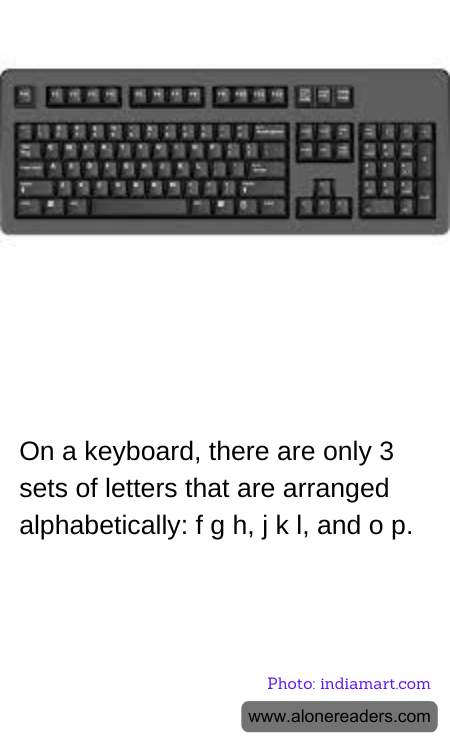
On a standard QWERTY keyboard, the layout is not typically thought of as intuitive for those learning to type, given its somewhat haphazard arrangement of letters. This layout was originally designed in the 19th century to prevent mechanical typewriter keys from jamming, rather than for speed of typing. Despite this, within this seemingly random layout, some order does exist in the form of small alphabetical sequences. Notably, there are three sets of letters arranged consecutively in alphabetical order: f-g-h, j-k-l, and o-p.
The 'f-g-h' sequence is located on the left-hand side of the middle row, serving as a small island of predictability amidst the chaos. This sequence is particularly notable because the 'f' and 'j' keys often have raised bumps or lines on them. These bumps help typists find the correct positioning on the keyboard without looking, serving as the home keys for the index fingers in touch typing.
Moving to the right on the same row, the 'j-k-l' sequence appears. Just like 'f-g-h,' these keys are also centrally located and play a critical role in touch typing. The 'j' key, mirrored by the 'f' on the left, also has a raised bump to guide the right index finger.
The third sequence, 'o-p,' is found on the top row and is the last pair of alphabetically consecutive keys. While shorter and less used compared to the other two sequences, it maintains the pattern of alphabetical order nonetheless.
These small sequences, though limited, are subtle reminders of order within the layout and provide a comforting regularity that can assist in the memorization and mastering of keyboard skills. Interestingly, these sequential clusters form a part of a typing foundation, making them essential for both novices and experienced typists for effective navigation and increased typing efficiency. Displaying both a historical design quirk and a practical feature, these alphabetically ordered sequences on a keyboard highlight a blend of design necessity and the utility that has carried on through the ages, from mechanical typewriters to modern keyboards.
