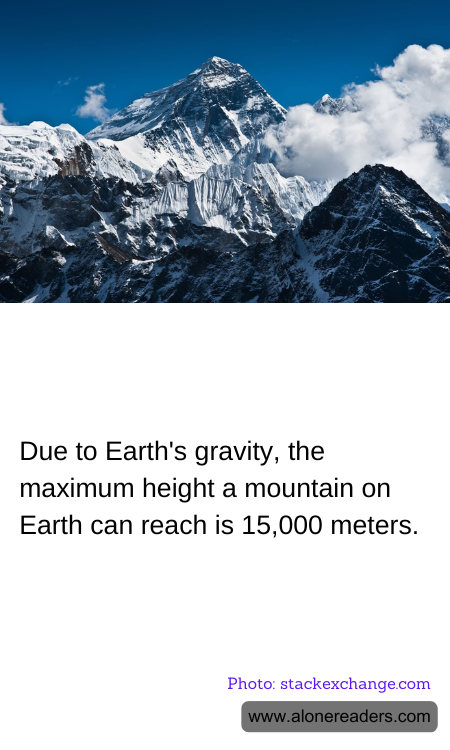
The intriguing concept of a mountain reaching 15,000 meters on Earth is a subject that blends geophysics with geological limits imposed by Earth's materials and gravitational strength. In reality, the maximum height of mountains on Earth is much lower than this theoretical limit, with the tallest mountain, Mount Everest, standing at about 8,848 meters above sea level.
The primary reason mountains cannot exceed certain heights, far below the 15,000 meter figure, stems from the interplay between gravitational forces and the material properties of the Earth’s crust. The concept of isostasy, which is the equilibrium that exists between parts of the Earth's crust, which "floats" at heights proportional to their thickness and density, is critical here. Essentially, as a mountain grows taller, it also must grow heavier, and at some point, the base of the mountain cannot support its increasing mass without sinking further into the mantle.
The crust and the upper mantle (collectively known as the lithosphere) are made of relatively rigid materials, but these materials do have their limits. When the weight of a mountain exceeds these limits, the rocks begin to fold and flow, effectively limiting the mountain's growth. Furthermore, erosion processes driven by weathering, wind, ice, and rain also continually wear down the height of mountains, counteracting tectonic uplift.
Moreover, the sheer force of Earth’s gravity itself also limits mountain height. Gravitational pull increases with mass, and as a mountain adds mass, the gravitational forces trying to pull it downwards become stronger. This relationship between gravitational forces and the mass of a mountain ensures there's a practical limit to how high mountains can grow.
The hypothetical height of 15,000 meters surpasses the physical capabilities of Earth's crustal materials under the force of Earth’s gravity. Such a height would likely result in a mountain whose base could not sustain its top, leading to collapse or subsidence. Furthermore, the intense pressure exerted by such a massive mountain would likely cause significant geological instability, including earthquakes and severe deformation of the Earth's crust.
In summary, while the idea of a 15,000-meter-tall mountain on Earth captivates the imagination, physical and geological limitations significantly restrict the maximum height mountains can attain. The interplay of material strength, gravitational forces, and erosive processes all ensure that mountains do not exceed their natural limits, preserving the dynamic balance of Earth’s surface.
