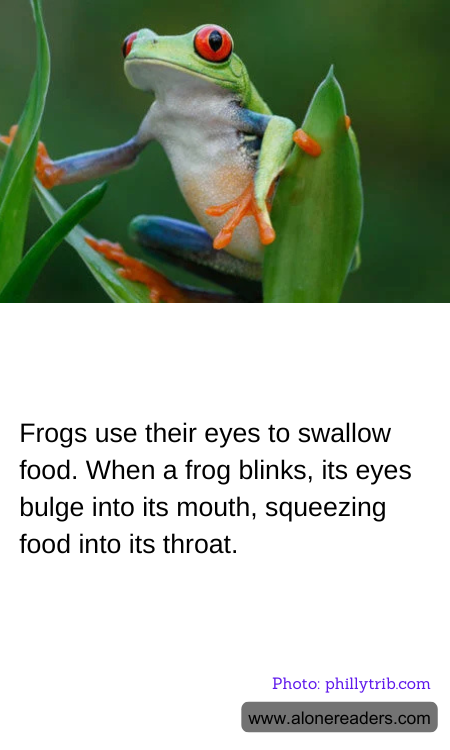
Frogs have a fascinating method of swallowing their food that involves the use of their eyes. Unlike many other animals, frogs do not chew their food but swallow it whole. Their eyes play a crucial role in this process. When a frog captures its prey, typically insects or small invertebrates, it might initially struggle to push it down its throat due to the absence of conventional swallowing muscles that are strong enough for the task.
To compensate for this, frogs use a unique swallowing mechanism. They close their eyes and retract them into their head, pressing them downward into the roof of their mouth. This action helps to physically push the food down their throat. Essentially, the eyes of a frog act as an additional limb that assists in food ingestion. When a frog blinks or closes its eyes tightly during eating, it's not merely blinking in the human sense but actively participating in the swallowing process.
This method is particularly vital because of the frog's anatomy and feeding habits. Frogs catch their prey with a sticky tongue that quickly lashes out and retracts back into the mouth. Once the prey is inside the mouth, efficient swallowing is critical since the prey, if alive, might attempt to escape or could cause harm if it remains active. By using their eyes, frogs ensure that the prey is pushed sufficiently into the esophagus and on towards digestion.
Moreover, this mechanism highlights the evolutionary adaptability of frogs. Their eyes are not only crucial sensory organs but also double as tools for consuming food. This dual functionality is an excellent example of how animals can evolve to maximize their chances of survival using the physical attributes they possess. Interestingly, not all frog species exhibit this feature to the same extent, which provides insights into the diverse evolutionary paths and environmental adaptations across the amphibian group.
