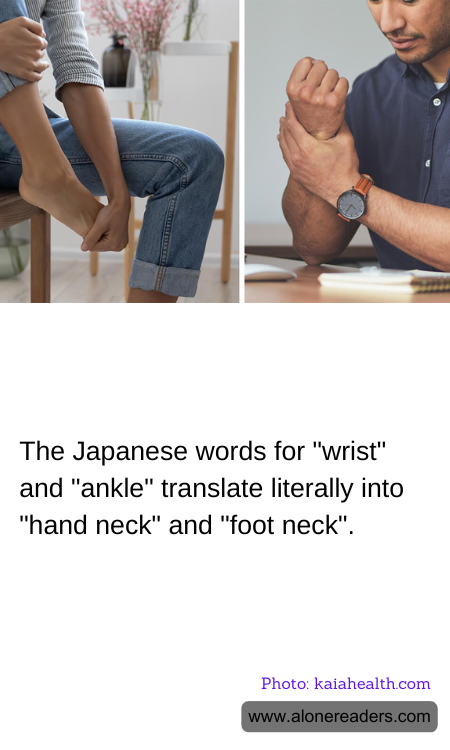
In Japanese, the words used for "wrist" and "ankle" carry an intriguing poetic clarity that describes these body parts in a unique, almost metaphorical way. The Japanese term for "wrist" is ?? (???, tekubi), where ? (te) means "hand" and ? (kubi) means "neck". Therefore, ?? (tekubi) translates literally as "hand neck". Similarly, the word for "ankle" in Japanese is ?? (????, ashikubi), composed of ? (ashi), meaning "foot", and again ? (kubi), meaning "neck". Thus, ?? (ashikubi) translates to "foot neck". This linguistic framing underscores a perspective in which the wrist and ankle are seen as the 'necks' of the limbs, highlighting their function as pivotal points of movement and flexibility, much like the neck supports and enables the movement of the head.
This fascinating linguistic choice reflects a broader trend within the Japanese language, which often employs such vivid, visual descriptions to define objects and concepts. It enhances the understanding of the body in both a literal and figurative sense, emphasizing the importance and functionality of these parts. In both cases, "neck" underlines the pivotal role these body parts play; just as the neck allows for the wide range of motion of the head and supports its weight, the wrists and ankles enable flexible, essential movements of the hands and feet.
These expressions offer not just a lesson in language but also one of anatomy and physiology, and they show how cultural perceptions and language interweave to influence our understanding of the body. Moreover, they provide an example of the beautiful, descriptive nature of Japanese – a language that often provides poetic descriptions of everyday items and concepts, enhancing both communication and the appreciation of the natural and physical world. This almost metaphorical use of language enriches dialogue and adds a layer of cultural insight that enhances learning and appreciation for non-native speakers exploring Japanese.
