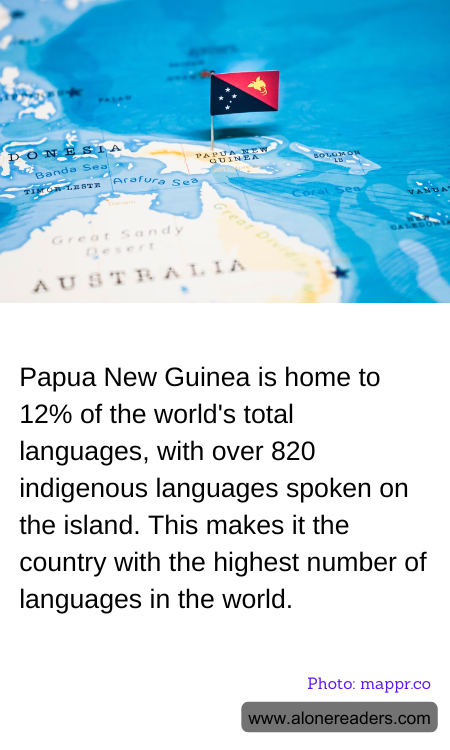
Papua New Guinea stands as one of the most linguistically diverse countries on the planet. Remarkably, it is home to 12% of the world’s languages, boasting over 820 indigenous languages across its various communities. This staggering number of languages is even more impressive when considering the country's relatively small size compared to larger, more populous nations. These languages are spread among a population of about nine million people and present a fascinating mosaic of linguistic diversity concentrated in an area of just 462,840 square kilometers.
The linguistic landscape of Papua New Guinea is a reflection of the country’s complex cultural tapestry. Each language serves as a vessel for the unique cultural practices, traditions, and histories of its speakers. The multitude of languages in the area is attributed to the rugged terrain and the isolated communities that have developed relatively undisturbed by external influences for thousands of years. The highland regions, in particular, have been a cradle for linguistic diversity, with valleys and mountains creating natural barriers that lead to the development of distinct linguistic groups within close geographic proximities.
Despite its richness, this linguistic diversity also presents significant challenges. Many of Papua New Guinea’s languages are spoken by only a few hundred to a few thousand people, making them highly vulnerable to extinction. As globalization progresses, there is a growing trend among younger generations to favor dominant languages such as Tok Pisin, English, and Hiri Motu, which are more widely spoken and are perceived as more useful in urban and business environments. This shift poses a threat to the survival of many indigenous languages unless significant cultural preservation efforts are undertaken.
Efforts to preserve linguistic diversity in the country are crucial. They include documentation projects, the integration of local languages in educational settings, and the promotion of cultural pride among the younger populations. These languages are not only communication tools but are also key to the identity and heritage of the communities that speak them. Preserving them is essential for maintaining the cultural richness of the region and for providing future generations with a deep connection to their ancestral past.
In conclusion, the linguistic diversity in Papua New Guinea is truly remarkable and highlights the cultural richness of the nation. Protecting this heritage is vital, as each language encapsulates unique perspectives and knowledge systems that contribute to the global cultural mosaic.
