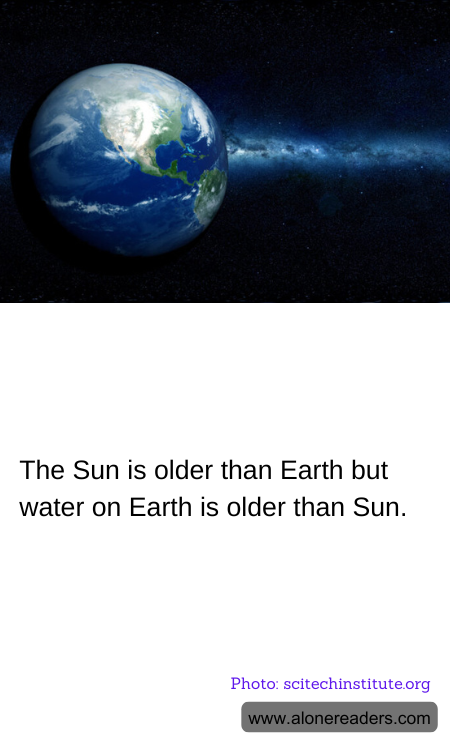
In the grand chronology of the universe, the age of celestial bodies and their constituents tells a fascinating tale about the origins and transformations of matter. Based on astronomical studies and models, scientists estimate that the Sun is about 4.6 billion years old. It formed from the gravitational collapse of a region within a large molecular cloud most commonly made up of hydrogen, along with helium and trace amounts of heavier elements.
Earth formed around 4.5 billion years ago, slightly later than the Sun, from the solar nebula — a disk-shaped cloud of gas and dust left over from the Sun’s formation. This process implies that our planet is younger than the Sun, yet, intriguingly, some of Earth’s water is indeed older than the Sun itself.
This ancient water's story begins in the cold, outer regions of the pre-solar nebula. Water, in the form of ice, likely coated the dust grains that eventually were part of the planetesimals — the building blocks of planets. Studies, particularly those involving the isotopic compositions of water in comets and meteorites (specifically the hydrogen isotopes deuterium and protium), suggest that a significant fraction of Earth’s water likely formed in the interstellar medium before our solar system’s formation.
When these planetesimals accreted to form Earth, they included ices that melted to become part of Earth’s oceans. Thus, some of the water on Earth predates the Sun and provides a unique window into the chemical processes that occurred long before our solar system existed. This ancient heritage makes water not just crucial for life on Earth but also a capsule of cosmic history, holding insights into the processes that shape planets and possibly other systems where life might emerge.
The discovery not only underscores the complex interdependencies between Earth's formation and earlier cosmic events but also highlights how celestial bodies are composed of materials that are far older than the bodies themselves. This revelation provides astronomers and planetary scientists with critical information about the early solar system’s evolution and the pivotal role of interstellar materials in shaping the environmental conditions necessary for life.
