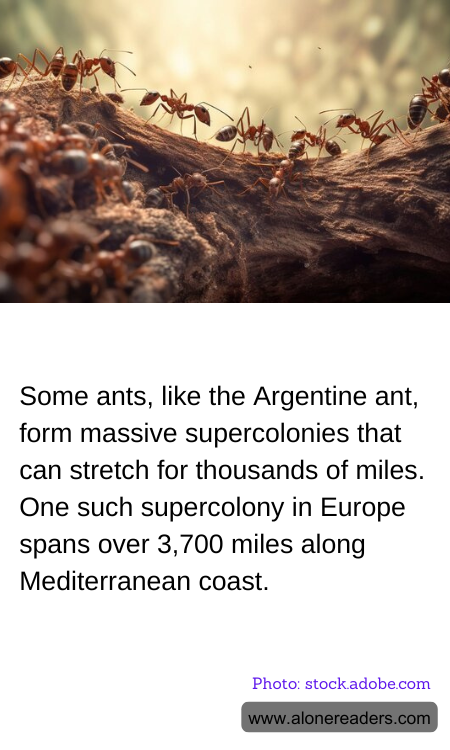
Ants are often regarded as some of the earth's most complex and organized societies, and the Argentine ant is an extraordinary example. Native to South America, Argentine ants are an invasive species that have spread to various parts of the world, including Europe, North America, and Australia. One of the most fascinating aspects of the Argentine ant is their ability to form supercolonies, expansive networks of nests that can house millions, or even billions, of interconnected individuals. Unlike other ant species that might aggressively defend their territories from outsiders, these ants exhibit a remarkable degree of cooperation and tolerance among members from different nests.
One of the largest known supercolonies of the Argentine ant is found stretching across the Mediterranean coast. This colossal colony spans an estimated 3,700 miles from Spain to Italy. Scientists have been intrigued by how these ants manage to maintain such a cohesive society over such enormous distances without fragmenting into hostile groups. This vast network is possible because the ants share a similar chemical profile, which makes it hard for them to differentiate kin from non-kin, promoting peaceful coexistence and cooperation. This uniformity in chemical signature likely stems from their shared genetics and common invasive origin.
The presence of such mega-colonies raises significant ecological concerns. Argentine ants are known for their aggressive displacement of native ant species and other insects, leading to reduced biodiversity. They also tend to farm aphids for honeydew, which can exacerbate issues with pests on crops and in gardens. Additionally, their sheer numbers and vast network make management and eradication attempts extremely challenging.
Moreover, these supercolonies provide valuable insights into the workings of complex social structures and cooperative behavior. The study of how Argentine ants communicate, make collective decisions, and resolve conflicts can offer models for understanding patterns of connectivity and cooperation in other biological systems, and even in human social and economic structures. Their extraordinary ability to form these massive cooperative groups challenges the traditional views of how large-scale sociality and cooperation evolve, providing a unique perspective on the balance between cooperation and competition in nature.
